Gimhae makes a manageable change of pace from Busan without a long-distance journey. Use the light rail as the backbone, then group the Gaya-history stops and the market area into a realistic walk. Back-cut pork is one food option, not an obligation. The useful part of this route is being able to connect history, neighbourhoods and dinner without turning the day into a transport exercise.
Gimhae rarely shouts for attention. Its royal tombs sit beside ordinary neighborhoods, students cross an archaeological park on the way to cafés, and one of the city’s most famous pork dishes is named after scraps once traded quietly through the back door.
That modesty is exactly why the city makes a memorable day trip. This route follows Gaya kings, iron and maritime exchange, then finishes among back-cut pork grills and the international kitchens of a modern market district.
Contents
- The route at a glance
- Getting from Busan to Gimhae
- Morning: King Suro and a royal love story
- Midday: tombs, iron and the missing pages of history
- Afternoon: Bonghwangdaegil and back-cut pork
- Evening: a market that speaks many languages
- What to eat in Gimhae
- Practical tips and common mistakes
The route at a glance
| Time | Area | Main experience |
|---|---|---|
| Morning | Busan → Gimhae | Metro and Busan–Gimhae Light Rail to the royal district |
| Late morning | Royal Tomb of King Suro | Quiet compound, Gaya founding story and twin-fish symbol |
| Midday | Sureungwon and Daeseong-dong | UNESCO tombs, archaeology and Gaya iron culture |
| Afternoon | Bonghwang-dong | Historic site, Bonghwangdaegil lanes and local lunch |
| Evening | Dongsang Market area | Multicultural food or one final market snack before Busan |
Best for: independent travelers staying in Busan who enjoy archaeology, walkable neighborhoods and food with a local backstory. Most of this route fits around the Suro Royal Tomb, Museum, Bonghwang and Buwon light-rail stations.
Getting from Busan to Gimhae
From Busan Station
Take Busan Metro Line 1 from Busan Station toward Seomyeon. At Seomyeon, transfer to Line 2 toward Sasang and get off at Sasang Station. Follow the signs for the Busan–Gimhae Light Rail (부산김해경전철), which is a separate elevated line connected to the transit complex.
Board a train toward Gaya University (가야대), not toward Sasang. For this itinerary, get off at Suro Royal Tomb Station (수로왕릉역) or Bonghwang Station (봉황역), depending on where you want to begin. The official Busan–Gimhae Light Rail route and fare page lists every station.
If you are starting at Gimhae International Airport, use the same light rail in the Gaya University direction and stay on it into central Gimhae. Do not board toward Sasang unless you are returning to Busan.
A rechargeable transportation card makes the transfers easier. Our T-money card guide and South Korea public transportation guide explain tapping in, transfers and card balance.
Morning: King Suro and a royal love story
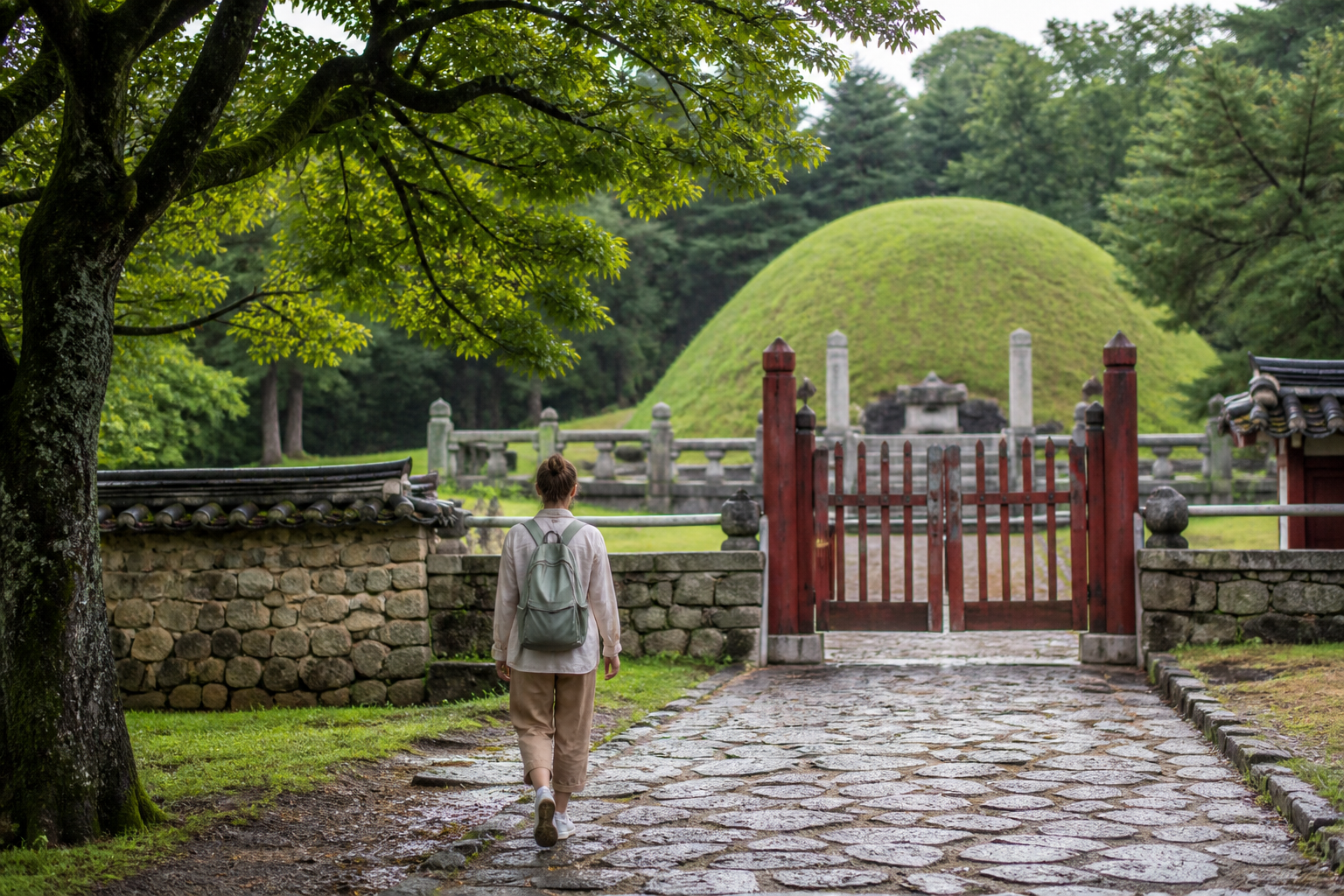
Walk from Suro Royal Tomb Station toward the Royal Tomb of King Suro (수로왕릉). The first impression is restraint rather than spectacle: a red gate, low buildings, old trees and a single rounded mound held away from the noise of the city.
King Suro is remembered as the founder of Geumgwan Gaya and an ancestor of the Gimhae Kim clan. The compound includes ritual buildings and stone monuments, but the detail that catches many international visitors is a twin-fish design near the tomb gate.
Local tradition connects that symbol to Queen Heo Hwang-ok, who is said in the Samguk Yusa tradition to have crossed the sea from Ayodhya to marry King Suro. The story has become an important cultural link between Korea and India. Treat it as a treasured founding narrative rather than a modern travel record with every detail proven.
The official Gimhae tourism page for the tomb provides current visiting information. Walk quietly, avoid interrupting ritual activity and give yourself time to notice the buildings rather than photographing only the mound.
Sureungwon: the path between two histories
Continue through Sureungwon Garden (수릉원), a landscaped green space connecting the royal tomb area with the Daeseong-dong tombs. The route is easy to underestimate because it looks like a city park. Its ponds, trees and curved paths create a pause between the written legend of a king and the archaeological evidence waiting on the next hill.
Midday: tombs, iron and the missing pages of history
The Daeseong-dong Tumuli (대성동고분군) are part of the Gaya Tumuli UNESCO World Heritage property. Their grassy forms may remind you of Gyeongju, but the historical voice is different. Gaya was a network of polities known for iron production, trade and maritime connections, not a simple early version of Silla.
Visit the Daeseong-dong Tombs Museum to see objects excavated nearby. Metal weapons, horse equipment, pottery and ornaments make the hill outside easier to read. The VisitKorea museum page provides a useful introduction.
If you want a deeper explanation or the weather turns bad, continue to the Gimhae National Museum near Museum Station. Its permanent galleries describe Gaya as both a kingdom of iron and a maritime kingdom. The museum is closed on Mondays and selected holidays, so check the official museum website before arranging the day around it.
There is a reason museums matter more here than in cities with long royal chronicles. Fewer written records of Gaya survive, so archaeologists must rebuild much of the story from things placed underground. A curved piece of iron or a clay vessel is not decoration; it is a sentence recovered from a missing book.
Afternoon: Bonghwangdaegil and back-cut pork
Walk south toward the Bonghwang-dong Historic Site (봉황동 유적). The area preserves traces of settlement life, shell deposits and the landscape of people who lived close to water and trade routes. Climb only where paths allow and look back toward the modern city. Gimhae’s strongest view is often this overlap: apartment towers beyond an ancient rise, with the light rail moving between them.
Bonghwangdaegil, formerly called Bongridan-gil
The nearby café and restaurant street is now promoted as Bonghwangdaegil (봉황대길), though many residents and older posts still call it Bongridan-gil (봉리단길). Small renovated buildings, bakeries and cafés occupy lanes close to the historic site. It is lively without feeling as polished or crowded as Seoul’s best-known café districts.
Choose one café, not four. The reward is sitting beside a window and watching a neighborhood continue around visitors—delivery scooters, grandparents, students and travelers all using the same narrow street for different reasons.
The honest local lunch: dwitgogi
For a distinctly Gimhae meal, look for dwitgogi (뒷고기), often translated as back-cut pork. The name is commonly explained through an old meat-trade story: after the standard cuts were prepared, flavorful leftover pieces were collected and quietly sold “out the back.”
Today it is not a secret scrap meal. Restaurants serve mixed pork pieces for grilling, valued for their changing textures—chewy, tender, fatty and lean in the same order. Grill in small batches, wait for browned edges and eat with salt, sauce, garlic or a leafy wrap.
Some restaurants require a minimum order, usually easier for two or more people. Solo travelers can choose pork soup, noodles or a market meal instead. Ask the total price before ordering and do not assume every menu portion is designed for one person.
Evening: a market that speaks many languages
Finish around Dongsang Market (동상시장) and the surrounding old downtown. Gimhae has a large and diverse migrant community, and the food streets near the market reflect it. Signs, spices and conversations can shift from Korean to languages from Central Asia, China, Mongolia, Southeast Asia and South Asia within a few blocks.
This makes a fitting final chapter. Ancient Gaya grew through iron and connections across the sea; modern Gimhae again reveals itself as a city shaped by people arriving, working and cooking from many places. The comparison is an interpretation, not a claim that the two eras are identical—but the walk makes the city’s openness feel tangible.
Try one unfamiliar dish at a busy specialist restaurant or keep things simple with a market pancake, dumplings or noodles. Look at posted menus, confirm whether meat is halal if that matters to you, and ask before photographing staff or customers.
From Buwon, Bonghwang or Suro Royal Tomb Station, take the light rail toward Sasang. Transfer to Busan Metro Line 2 at Sasang, then change at Seomyeon for Line 1 to Busan Station. If your Busan evening continues with local food, our Busan local food itinerary provides the next chapter.
What to eat in Gimhae
| Korean name | What it is | Best moment |
|---|---|---|
| 뒷고기 | Mixed flavorful pork cuts grilled at the table | Lunch or early dinner for two or more |
| 돼지국밥 | Pork and rice soup with seasonings added to taste | Easy solo meal near a station |
| 시장 칼국수 | Hand-cut noodle soup in a simple broth | Cool or rainy day |
| 진영 단감 | Sweet persimmons associated with Jinyeong | Autumn market snack or gift |
| 다문화 음식 | Central Asian, Chinese, Mongolian, South or Southeast Asian dishes | Dongsang Market evening |
Carry a little cash for smaller market stalls, although many restaurants accept cards. Our South Korea money guide explains cards, ATMs and tipping.
Practical tips and common mistakes
- Board the correct light-rail direction. Use Gaya University direction from Sasang or the airport, and Sasang direction when returning.
- Save Korean station names. Use 수로왕릉역, 박물관역, 봉황역 and 부원역.
- Do not visit the National Museum on Monday. Check holiday closures and special-gallery notices as well.
- Treat the Queen Heo story carefully. It is an important historical tradition and cultural connection, not a fully documented modern itinerary.
- Wear walking shoes. The route is compact but includes parks, tomb paths and uneven historic ground.
- Ask about minimum orders. Grilled-pork restaurants may expect two portions or more.
- Use both names for the café street. Search 봉황대길 and 봉리단길 if one produces few map results.
- Leave room for the market. The most memorable meal may be the one you did not plan in advance.
Can Gimhae be a half-day trip?
Yes. For a shorter visit, take the light rail to Suro Royal Tomb Station, see the royal tomb and Sureungwon, walk through the Daeseong-dong tombs, then eat around Bonghwangdaegil before returning from Bonghwang Station. Add the National Museum and Dongsang Market when you have a full day.
Choose the half-day or full-day route
For half a day, use the shorter tombs-and-neighbourhood route above. With a full day, add the museum and market without rushing the meal. Check the return connection before sitting down to dinner; the light rail makes the journey convenient, but your final connection in Busan still matters.