This Busan route starts with a reader’s everyday knowledge of Yongho-dong: pork soup, coastal walks and the seafood choices around Seopjari. It is an alternative to building the whole trip around Haeundae and Gwangalli. Choose either Igidae or Oryukdo according to your walking plans, then keep one evening area. Gijang is better treated as a separate day than another stop to squeeze in.
This route began with a recommendation shared by someone who knows Busan from everyday life—not just from a list of famous attractions. That changes the rhythm of the trip. Instead of racing between landmarks, you eat where residents eat, walk until the city noise disappears, and let the harbor lights decide how the evening ends.
The short version: Hapcheon Gukbapjip in Yongho-dong → Igidae or Oryukdo Sunrise Park → seafood around Seopjari → choose Yeongdo Pojangmacha Street or Nampo-dong markets and Yongdusan Park for the evening. Save Gijang and the OSIRIA area for a separate day.
Table of Contents
- Route at a glance
- Getting here from Busan Station
- Start with pork soup in Yongho-dong
- Walk from the neighborhood to the sea
- Seafood around Seopjari
- Evening option A: Yeongdo pojangmacha
- Evening option B: Nampo markets and Yongdusan
- Day-two extension: Gijang and OSIRIA
- How to get around
- Frequently asked questions
The Route at a Glance
| Stop | Why go | Suggested time |
|---|---|---|
| Hapcheon Gukbapjip | Clear, comforting Busan-style pork soup in a local neighborhood | Late morning or early lunch |
| Igidae Coastal Trail | Cliffs, forest, sea wind, and a less urban side of Busan | 1–3 hours depending on route |
| Oryukdo Sunrise Park & Skywalk | Open-sea views and the dramatic end of the coastal trail | 45–90 minutes |
| Seopjari area | Indoor-pocha-style eel, hagfish, and sashimi restaurants | Late afternoon or dinner |
| Yeongdo or Nampo-dong | Harbor tents or markets followed by a city night view | Evening |
Trying to complete every stop in one day can feel rushed. Pick either a shorter section of Igidae or Oryukdo, and choose only one evening route. Busan rewards travelers who leave room for a slow meal and an unplanned view.
How to Get to Yongho-dong from Busan Station
Hapcheon Gukbapjip is not beside a subway station, so the final part of the trip requires a bus, taxi, or a short walk from a neighborhood bus stop. Save both 합천국밥집 and 부산 남구 용호로 235 in NAVER Map before leaving Busan Station.
Option 1: Direct Bus 27 — Fewest Transfers
- Leave the KTX concourse and use NAVER Map to locate the roadside stop named Busan Station (부산역) served by Bus 27.
- Check that the bus is traveling toward Yongho-dong / Oryukdo SK View, not in the opposite direction.
- Ride Bus 27 to Yongho 2-dong Community Service Center (용호2동행정복지센터).
- From the stop, walk approximately 350 meters—about five to seven minutes—to 235 Yongho-ro. Keep the Korean restaurant name open because the storefront is modest.
This is the simplest public-transport option because it avoids a subway transfer. Allow roughly an hour, and more during weekday rush hour or weekend congestion. Busan’s official geopark directions also identify Bus 27 as the direct route from Busan Station toward Igidae and Oryukdo.
Option 2: Subway Plus Local Bus — Easier to Follow in Heavy Traffic
- Enter Busan Station on Metro Line 1.
- Take a train in the Nopo direction and get off at Seomyeon Station.
- Transfer to Line 2 toward Jangsan.
- Get off at Kyungsung University–Pukyong National University Station and use Exit 5.
- Board a Yongho-dong-bound bus such as 20, 22, 24, 27, 39, or 131. Confirm the live route before boarding.
- Get off at Yongho 2-dong Community Service Center, then walk about five to seven minutes to Hapcheon Gukbapjip.
The subway section is predictable, but the bus connection can involve waiting. This route is useful when traffic near central Busan is slow or when you feel more comfortable making the longer part of the journey by metro.
Option 3: Taxi — Best with Luggage or Two or More Travelers
Show the driver “합천국밥집, 부산 남구 용호로 235”. Travel time varies widely with port and city traffic, so check the live estimate in k.ride or another taxi app before confirming. A taxi is the easiest option if you have luggage, limited mobility, or want to begin the coastal walk without spending energy on transfers.
Can You Walk from Busan Station?
Technically yes, but it is not a useful sightseeing walk. The road route is roughly eight kilometers or more and can take over two hours, much of it beside busy urban roads and port traffic. Take public transportation to Yongho-dong and save your walking energy for Igidae.
Continue to Igidae or Oryukdo After Lunch
Return to a Yongho-dong bus stop and check the direction carefully. For Igidae Entrance (이기대입구), local routes include 20, 22, 24, 27, 39, and 131. For Oryukdo Skywalk (오륙도 스카이워크), the clearest official route uses buses 24, 27, or 131. If you want to start at a specific coastal-trail entrance rather than a major stop, a short taxi ride is often easier.
Bus stops, construction, and travel times can change. Recheck the same-day route in NAVER Map and compare it with the official Busan Geopark transportation guidance.
A Bowl of Busan: Hapcheon Gukbapjip in Yongho-dong
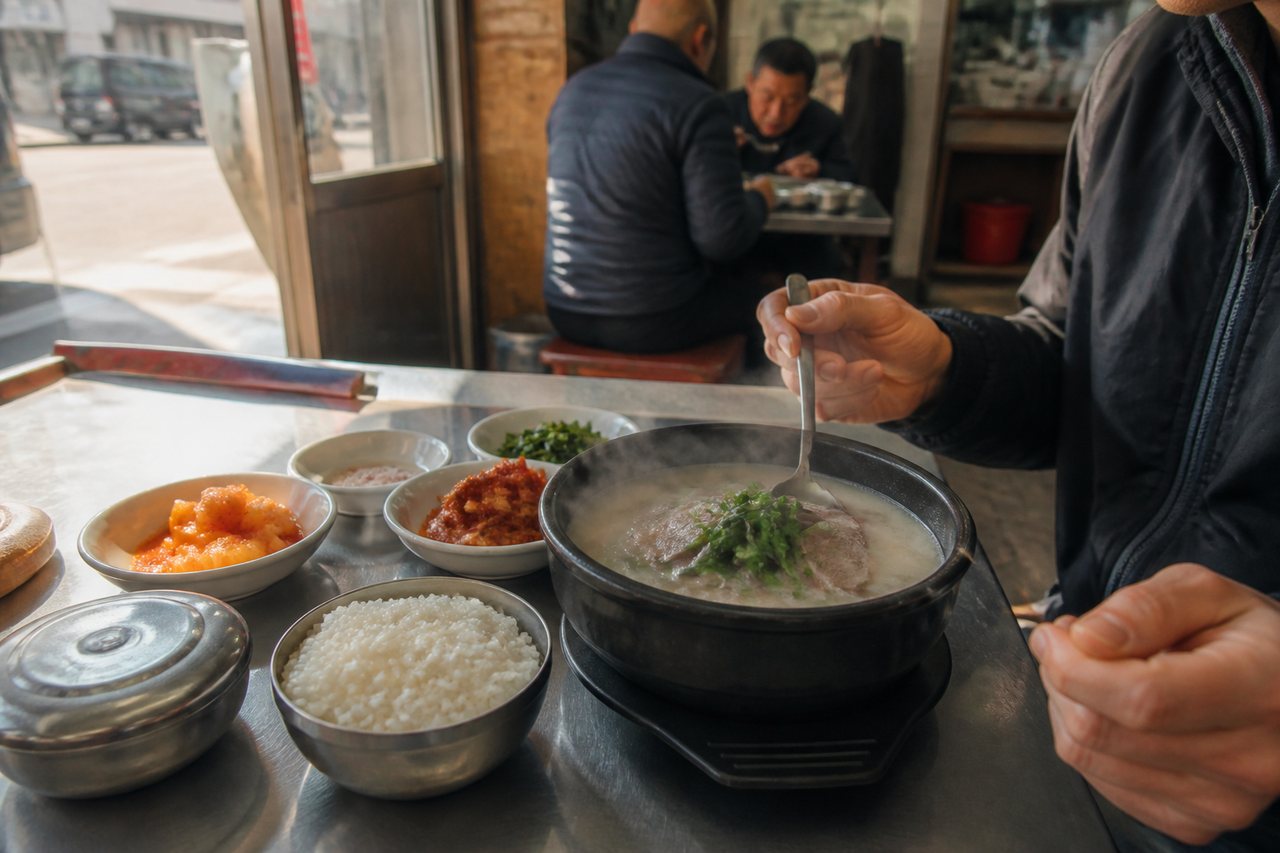
The first impression is not luxury. It is the sound of spoons against metal bowls, the quiet concentration of people eating, and broth arriving hot enough to fog your glasses. This is Hapcheon Gukbapjip (합천국밥집), at 235 Yongho-ro, Nam-gu, Busan—the street address for the local address you shared, Yongho-dong 554-3.
Hapcheon Gukbapjip appears in the 2026 MICHELIN Guide Busan selection. It is important to describe that correctly: it is a MICHELIN Guide restaurant, not a one-star fine-dining restaurant. Its appeal is almost the opposite of ceremony. The soup is known for a comparatively clear, clean-tasting broth that lets the pork speak before the seasoning does.
For a first order, say “Dwaeji gukbap hana juseyo” (돼지국밥 하나 주세요)—“One pork soup, please.” If you prefer the rice served separately, add “Bap ttaro juseyo” (밥 따로 주세요). Taste the broth before adding salted shrimp, chives, or spicy seasoning. The small ritual matters: local diners adjust the bowl gradually rather than turning every spoonful red at once.
- Korean name: 합천국밥집
- Address: 부산 남구 용호로 235 / 235 Yongho-ro, Nam-gu, Busan
- What to try: dwaeji gukbap; ask about mixed cuts if you enjoy different textures
- Local etiquette: order simply, keep bags out of narrow aisles, and do not linger at a busy lunch table
- Before visiting: search the Korean name in NAVER Map and confirm that day’s hours or break time
If you have not set up Korean navigation yet, use our guide to the best apps for South Korea travel. Copying the Korean name into a local map is more reliable than searching an improvised English spelling.

After Lunch, Follow Yongho-dong Toward the Sea
The clever part of eating in Yongho-dong is what comes next. You are already close to one of Busan’s finest coastlines. The apartment blocks and neighborhood shops begin to thin out, pine trees appear, and the air changes before the sea fully comes into view.
The Igidae Coastal Trail stretches about 4.7 kilometers from Dongsaengmal to Oryukdo and takes roughly 2.5 hours for the full walk, according to Visit Busan. It is not a flat promenade. There are stairs, uneven sections, and climbs, so wear proper shoes and carry water.
You do not need to walk the entire trail. For a gentler afternoon, visit a viewpoint near Dongsaengmal and continue by taxi or bus toward Oryukdo. For the full experience, walk south with the sea on your left. Waves strike the dark rock terraces below, and the towers of the city slowly feel less important.
Oryukdo Sunrise Park and the Skywalk
At the southern end, Oryukdo Sunrise Park opens toward the islets that mark the meeting point of Busan’s eastern and southern seas. The glass skywalk adds a brief thrill, but the wider landscape is the real reason to come. On windy or wet days, access may be restricted, so treat the skywalk as a bonus rather than the whole destination.
From Kyungsung University–Pukyong National University Station on Line 2, buses 24, 27, and 131 serve the Oryukdo direction. If you are moving directly from the restaurant or carrying hiking gear, a short taxi ride is usually simpler. Check the live route before leaving because bus stops and traffic conditions can change.
Seopjari: The Seafood Stop That Feels More Local
Near Yongho-dong’s waterfront, the Seopjari area is known locally for indoor-pocha-style seafood restaurants. The room may be brighter and more practical than romantic: tanks near the entrance, laminated menus, metal tables, and groups sharing plates. That is part of the charm.
Depending on the restaurant and season, you may find grilled eel, kkomjangeo (꼼장어, hagfish), sliced raw fish, shellfish, or simple seafood side dishes. Individual businesses change more often than major attractions, so search “용호동 섶자리 장어”, “섶자리 꼼장어”, or “섶자리 횟집” in NAVER Map on the day you visit.
Before ordering seafood sold by size or weight, confirm the price. You can ask “Igeo eolmayeyo?” (이거 얼마예요?)—“How much is this?” Point to the item and use a calculator if needed. For two people, ask whether a small portion is enough before accepting a large set.
The local way to enjoy this area is not to collect famous restaurant names. It is to choose a busy room, ask what is good that day, and let the sea decide the menu.

Evening Option A: Yeongdo’s Harbor Pojangmacha
When evening reaches Yeongdo, the harbor becomes a wall of small moving lights. Fishing boats rock in the dark water, the city glows across the channel, and tent lights pull diners toward red plastic stools. Yeongdo Pojangmacha Street is not polished nightlife. It feels temporary, social, and close to the working port.
The official Visit Busan guide to Yeongdo places the street around 42 Bongnaenaru-ro. Stalls commonly become active from early evening, especially from spring through fall, but exact days and hours depend on weather and the individual vendor. Have a backup restaurant saved in case the tents are closed.
Order one or two dishes first—grilled squid, clams, fish, or whatever is clearly fresh—then add more if you are still hungry. Ask the price before ordering and remember that menus may be mostly Korean. Papago’s camera translation helps, but friendly pointing works surprisingly well.
From Nampo Station or Busan Station, a taxi is the easiest choice at night. Public buses cross Yeongdodaegyo Bridge, but the last walk can feel less obvious after dark. If you drink, do not attempt a long coastal walk afterward; return by taxi or bus.
Evening Option B: Nampo-dong Markets and Yongdusan Park
If you prefer a busier and easier-to-navigate evening, cross toward Nampo-dong. The alleys around Gukje Market, BIFF Square, and Bupyeong Kkangtong Market carry the smell of frying batter, sweet syrup, fish cake broth, and grilled food. This is the place to snack, not to build a heroic checklist.
- Ssiat hotteok: a sweet fried pancake filled with seeds
- Busan eomuk: fish cake served on skewers or in hot broth
- Bibim dangmyeon: chewy glass noodles mixed with a spicy-sweet sauce
- Market rule: try small portions and leave room for whatever looks best in the next alley
Bupyeong Kkangtong Market is near the wider Nampo market district and is known as Korea’s first permanent night market. Food offerings and operating schedules can change, so check the official market or map listing before making it the final meal of your day.
End Above the City at Yongdusan Park
After the market, walk toward Gwangbok-ro and take the escalator up to Yongdusan Park. At ground level, Nampo-dong can feel dense and noisy. From the park, the same city becomes a pattern of bridges, port cranes, rooftops, and moving headlights.
The park itself is free and always accessible. The Diamond Tower observatory keeps separate ticketing hours; Visit Busan currently lists daily operation from 10:00 to 22:00 with last ticketing at 21:30. Confirm before visiting. From Nampo Station Exit 7, the park is about a seven-minute walk.
Do Not Rush Gijang: Make It a Second Day
Gijang looks close on a map of Busan, but combining it with Yongho-dong, Yeongdo, and Nampo-dong creates a day spent mostly in transit. Give the eastern coast its own morning.
Start early at Haedong Yonggungsa Temple, where stone stairs descend toward a temple built against the sea. Visit quietly, avoid blocking worshippers for photos, and remember that this is an active religious site. The current official listing gives the address as 86 Yonggung-gil, Gijang-eup and recommends access from OSIRIA Station on the Donghae Line with a local bus connection.
After the temple, choose your pace. Families may spend several hours at Lotte World Adventure Busan. Shoppers can visit the large outlet in the OSIRIA tourism complex. Trying to do the temple, theme park, outlet, and a long dinner in one day is possible but rarely enjoyable—choose two.
How to Travel This Route Without Stress
- Use transit for the main approach: Line 2 brings you toward the Nam-gu and coastal areas.
- Use taxis for the awkward gaps: Yongho-dong to a trail entrance, the waterfront to Yeongdo, or late-night returns.
- Keep Korean names saved: 합천국밥집, 이기대, 오륙도 스카이워크, 영도 포장마차거리, 부평깡통시장, 용두산공원.
- Carry a T-money card: it is useful on Busan subways and local buses.
- Check the last route: do this before sitting down at a night market or pojangmacha.
Our South Korea public transportation guide explains bus and subway basics, while the T-money card guide covers buying and reloading the card. Keep some cash as a backup for small stalls and read our South Korea money guide before visiting traditional markets.
Frequently Asked Questions
Is Hapcheon Gukbapjip a one-star MICHELIN restaurant?
No. It is included in the 2026 MICHELIN Guide Busan selection, but it is not one of Busan’s one-star restaurants. Describe it as a MICHELIN Guide-selected pork soup restaurant.
Can I visit Igidae and Oryukdo without hiking the full trail?
Yes. Visit a shorter Igidae viewpoint, then take a taxi or bus to Oryukdo Sunrise Park. This is better for travelers with limited time or anyone uncomfortable with stairs and uneven coastal paths.
Which evening is better: Yeongdo or Nampo-dong?
Choose Yeongdo for harbor atmosphere, seafood, and a less polished local night. Choose Nampo-dong for easier navigation, many snack options, covered market areas, and the Yongdusan Park view.
Is this route suitable in bad weather?
Skip the long coastal trail during heavy rain, strong wind, or extreme heat. Enjoy the pork soup, choose indoor seafood or market stops, and move to Yongdusan Park only if visibility improves.
Choose one evening district
Treat the Yongho-dong meal and coastal walk as the core of this route. Add one evening district if time allows. Yeongdo, Nampo-dong and Gijang each deserve their own transport check; a recommendation from someone who knows Busan still needs to fit your arrival time, energy and last journey back.
Restaurant hours, market stalls, prices, coastal access, and attraction schedules can change. This guide was checked against official Busan tourism and municipal information in August 2026. Confirm same-day details in NAVER Map or with the venue before traveling.