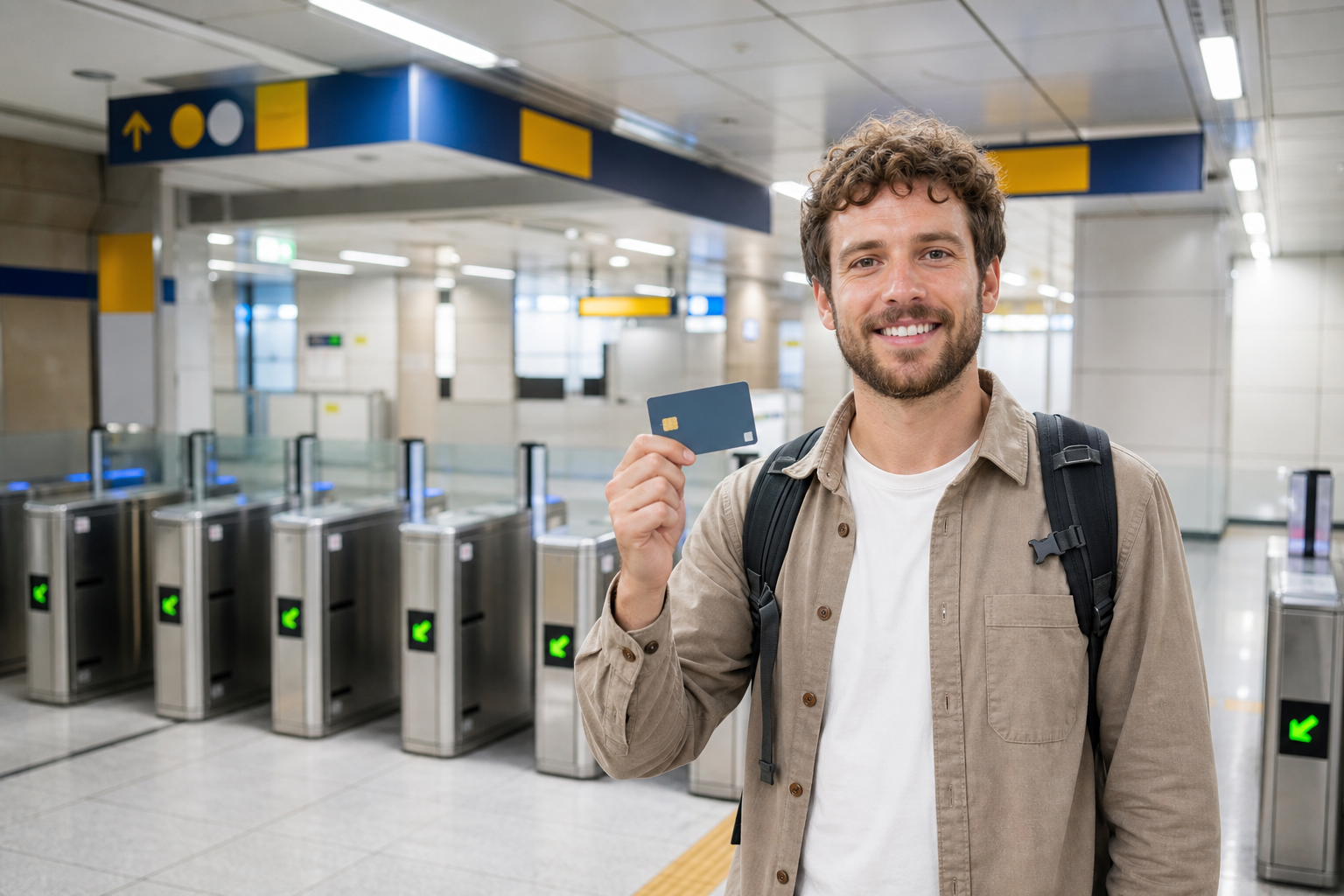
A T-money card in Korea is one of the easiest ways to use public transportation in South Korea.
Instead of buying a separate ticket for every subway or bus ride, you can load money onto the card and tap it whenever you travel. It works across much of the country and can also be used at selected stores and other participating locations.
This beginner-friendly guide explains where to buy a T-money card, how much it costs, how to recharge it, how to use it on subways and buses, and what to do with the remaining balance before you leave Korea.
New to Korea’s transport system? Read our South Korea public transportation guide for a complete overview of subways, buses, fares, and navigation apps.
Table of Contents
1. What Is a T-money Card?
T-money is a rechargeable prepaid transportation card. You add a balance to the card before traveling and tap it on a card reader when entering and leaving the transport system.
For most first-time visitors, a standard physical card is the simplest option. It does not require a Korean bank account, and a regular card can generally be purchased without registration or identification.
The plastic card and the stored balance are separate costs. Buying the card gives you the card itself; you must then add money before your first ride.
2. Where Can You Use a T-money Card?
T-money can be used on most public transportation networks in South Korea, including many:
- city subways
- city and local buses
- airport transportation services that display the T-money logo
- taxis with compatible card readers
- selected intercity and express transport services
The card can also be used at participating convenience stores, vending machines, and other businesses displaying the T-money logo. Acceptance can vary, so look for the logo or ask the cashier before paying.
3. Where to Buy a T-money Card
The easiest place to buy a card is usually a convenience store. Major chains such as CU, GS25, and 7-Eleven commonly sell transportation cards, although stock and designs vary by location.
You may also find cards at subway station information centers and selected ticket machines. At Incheon International Airport, check convenience stores and transportation-card vending machines in the arrival area.
Say “T-money card, please” and tell the cashier how much you want to add. The cashier can often sell and recharge the card in one transaction.
4. How Much Does a T-money Card Cost?
A standard card generally costs about 3,000 to 5,000 Korean won. Special character designs and tourist versions can cost more.
The purchase price is normally not part of your usable balance and is generally not refundable. For example, if a card costs 4,000 won and you want 30,000 won available for travel, you will pay about 34,000 won in total.
Prices and available card types can change. Check the current details on the official VISITKOREA transportation card guide before your trip.
5. How to Recharge a T-money Card
You can recharge the card at many convenience stores and subway ticket machines.
- At a convenience store: Hand the card to the cashier, state the amount, and pay for the recharge.
- At a subway station: Use a compatible recharge machine, select an available language, place the card on the reader, choose the amount, and insert payment.
Cash remains the most reliable payment method for visitors. Some machines or services may support other payment methods, but foreign-issued cards are not accepted everywhere. Keep a few Korean won banknotes available for recharging.

6. How Much Money Should You Load?
For a short trip, starting with 20,000 to 40,000 won is practical for many travelers. The right amount depends on how long you are staying, how many rides you take, and whether you travel outside Seoul.
A cautious approach is to start with a moderate balance and add more later. Convenience stores and subway stations are common, so there is usually no reason to load a very large amount at once.
7. How to Use T-money on the Subway
Using the card on the subway is simple:
- Find the correct subway line and direction.
- Place the card flat on the reader at the entrance gate.
- Wait for the confirmation sound or light.
- Enter through the gate and keep the card with you.
- Tap the same card again at the exit gate.
The display usually shows the fare charged and the remaining balance. If the gate does not open, do not force it. Try tapping again slowly or ask station staff for help.

8. How to Use T-money on a Bus
On most city buses, board through the front door and tap the card on the reader near the driver. A sound and screen message confirm the payment.
Before your stop, press a stop button. When leaving, tap the card again on the reader near the rear door. Tapping when you exit is important because it records the distance traveled and may be required for transfer discounts.
9. Transfers and Fare Discounts
One of the main advantages of using a transportation card is the integrated transfer system. Depending on the city, route, and transfer timing, you may receive a discounted or included transfer between buses and subways.
Always tap when entering and exiting. If you forget to tap out on a bus, the system may not apply the correct transfer benefit, and a later fare calculation may be affected.
10. How to Check Your T-money Balance
The remaining balance normally appears briefly on the reader whenever you tap. You can also ask a convenience-store cashier to check it or place the card on a compatible subway recharge machine.
Check the balance before a long journey or airport transfer. If the balance is too low when you exit the subway, use a fare-adjustment machine or ask station staff for assistance.
11. Refunding the Remaining Balance
Small remaining balances can often be refunded at participating convenience stores or service locations. A service fee may be deducted, and the original card purchase price is generally not returned.
According to current official tourism information, refunds above 50,000 won require a visit to Tmoney Town near Seoul Station. Rules and eligible locations can change, so confirm the latest refund details before departure.
For a very small balance, the easiest option may be to spend it at a participating convenience store. The official T-money travel card page provides current information for international visitors.
12. Common Mistakes to Avoid
- Forgetting to recharge: Check the balance before entering a station or boarding a bus.
- Using different cards during one trip: Each traveler should use the same individual card when entering and exiting.
- Forgetting to tap off a bus: This can affect transfer discounts and fare calculations.
- Loading too much money: Start with a moderate amount and recharge when necessary.
- Assuming every machine accepts foreign cards: Carry cash for the most reliable recharge experience.
- Confusing a prepaid balance with an unlimited pass: A standard T-money card deducts the fare for each journey.
Frequently Asked Questions
Can two people share one T-money card?
Each traveler should have a separate card for ordinary subway and bus travel. The transport system needs to match each person’s entry, exit, and transfer records.
Can I buy a T-money card at Incheon Airport?
Cards are commonly available at airport convenience stores and selected transportation-card vending machines. Availability can vary by terminal and store.
Can I recharge with an international credit card?
Do not depend on it. Payment options vary, and many recharge points still require cash or a Korean-issued card. Korean won is the safest option for visitors.
Does the card expire?
Physical T-money cards are reusable, so you can keep the card for a future trip. Card types and stored-balance rules can differ, so check the official terms if the card has been unused for a long time.
Final Thoughts
A T-money card makes traveling around South Korea much easier. Buy one soon after arriving, load a reasonable amount, and remember to tap both when entering and leaving public transportation.
With a transportation card, a local navigation app, and a little cash for recharging, first-time visitors can use Korea’s subway and bus systems with confidence.
For more essential preparation advice, see our South Korea travel tips for first-time visitors.