Category: Korea Travel Guide

  • South Korea Money Guide: Cash, Cards, ATMs and Tipping

    South Korea Money Guide: Cash, Cards, ATMs and Tipping

    This South Korea money guide explains how to pay confidently from the moment you arrive. Korea is highly card-friendly, but a small amount of cash is still useful for transportation-card top-ups, traditional markets, and the occasional small business.

    The safest plan is simple: bring two payment cards, keep some Korean won as backup, and never depend on a single ATM or mobile wallet. This guide covers cards, cash, ATMs, exchange, tipping, and common payment mistakes for first-time visitors.

    Still planning your trip? Start with our South Korea travel tips for first-time visitors.

    Table of Contents

    1. Quick Answer: Should You Use Cash or Card in South Korea?

    Use a credit or debit card for most hotels, restaurants, cafés, department stores, convenience stores, and attractions. Keep Korean won for places that do not accept foreign cards and for situations where a machine requires cash.

    Payment MethodBest ForMain Limitation
    Credit cardHotels, shops, restaurants, attractionsForeign cards may occasionally be declined
    Debit cardPurchases and ATM withdrawalsYour bank may charge foreign transaction or withdrawal fees
    Korean won cashMarkets, small vendors, transit top-upsLess convenient and easier to lose
    Prepaid travel cardBudget control and everyday paymentsRequires loading and may have service limits

    A practical combination is one primary card, one backup card stored separately, and a modest cash reserve. Many short-term visitors find that ₩50,000 to ₩100,000 is a useful starting backup amount, although your needs will depend on your itinerary and spending style.

    2. Understanding Korean Won

    South Korea’s currency is the Korean won, written as KRW or with the symbol ₩. Common banknotes are ₩1,000, ₩5,000, ₩10,000, and ₩50,000. Common coins include ₩10, ₩50, ₩100, and ₩500.

    Prices can look large if you are used to currencies with smaller numbers. A meal may cost several thousand won, and a hotel may cost more than one hundred thousand won per night. Check the current exchange rate before your trip and use a currency-converter app for quick estimates.

    The official VISITKOREA currency guide confirms that cards are widely accepted and recommends banks or authorized exchange centers for foreign-currency exchange.

    3. Using Foreign Credit and Debit Cards

    Major international cards are accepted at most tourist-facing businesses. Visa and Mastercard generally have the broadest acceptance, while American Express and other networks may work at many larger merchants but not everywhere.

    • Enable international transactions before departure.
    • Check whether your card charges a foreign transaction fee.
    • Carry a second card from a different network if possible.
    • Know your card PIN, because some terminals and ticket machines may request it.
    • Keep your bank’s fraud-alert contact method available.

    A declined payment does not always mean your account has a problem. The merchant’s terminal may not support the card, the transaction may trigger fraud protection, or an offline terminal may require a different verification method. Try your backup card or pay in cash instead of repeatedly attempting the same card.

    4. When You Still Need Cash

    South Korea is not cashless in every situation. Korean won can be useful at traditional markets, street-food stalls, small rural businesses, coin-operated lockers or machines, and some locally run guesthouses. Cash is also commonly needed when loading a standard transportation card at a subway machine or convenience store.
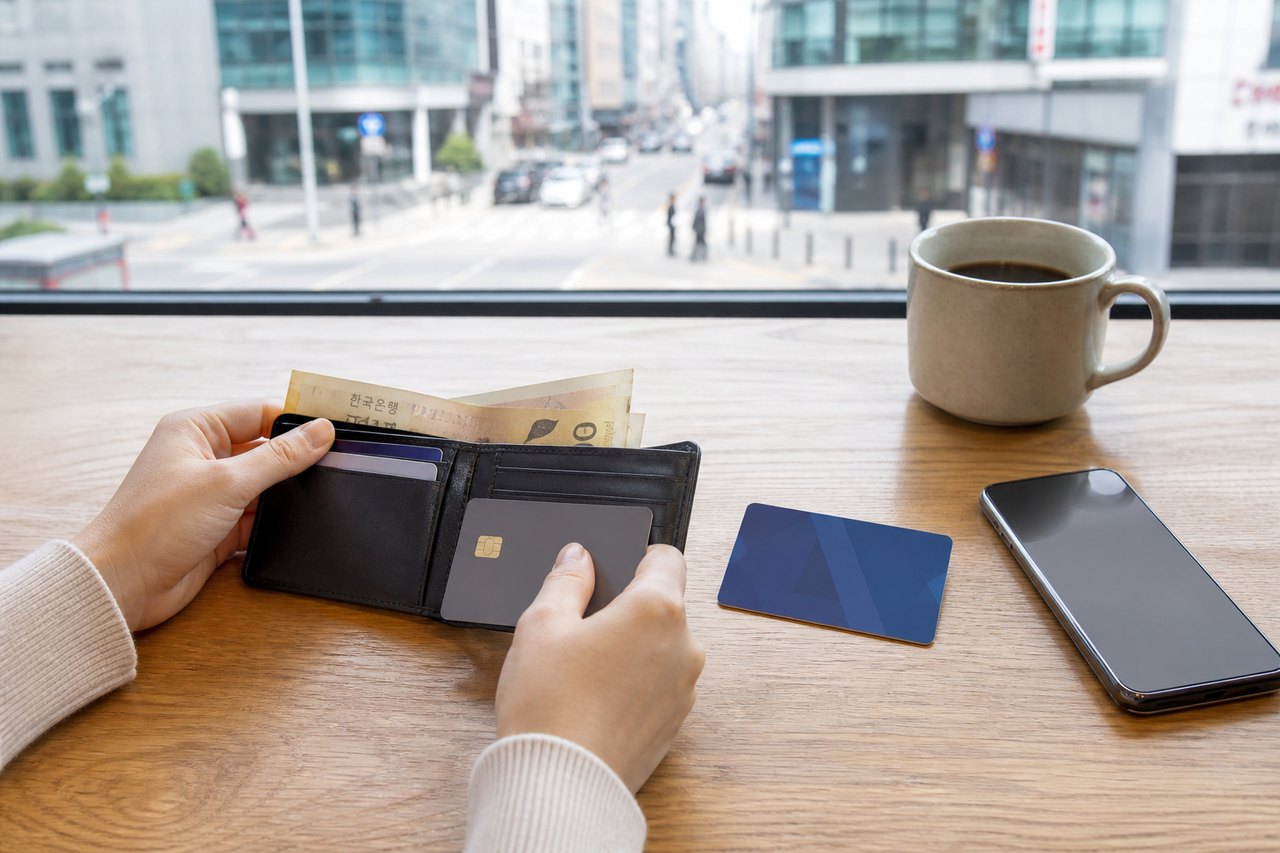
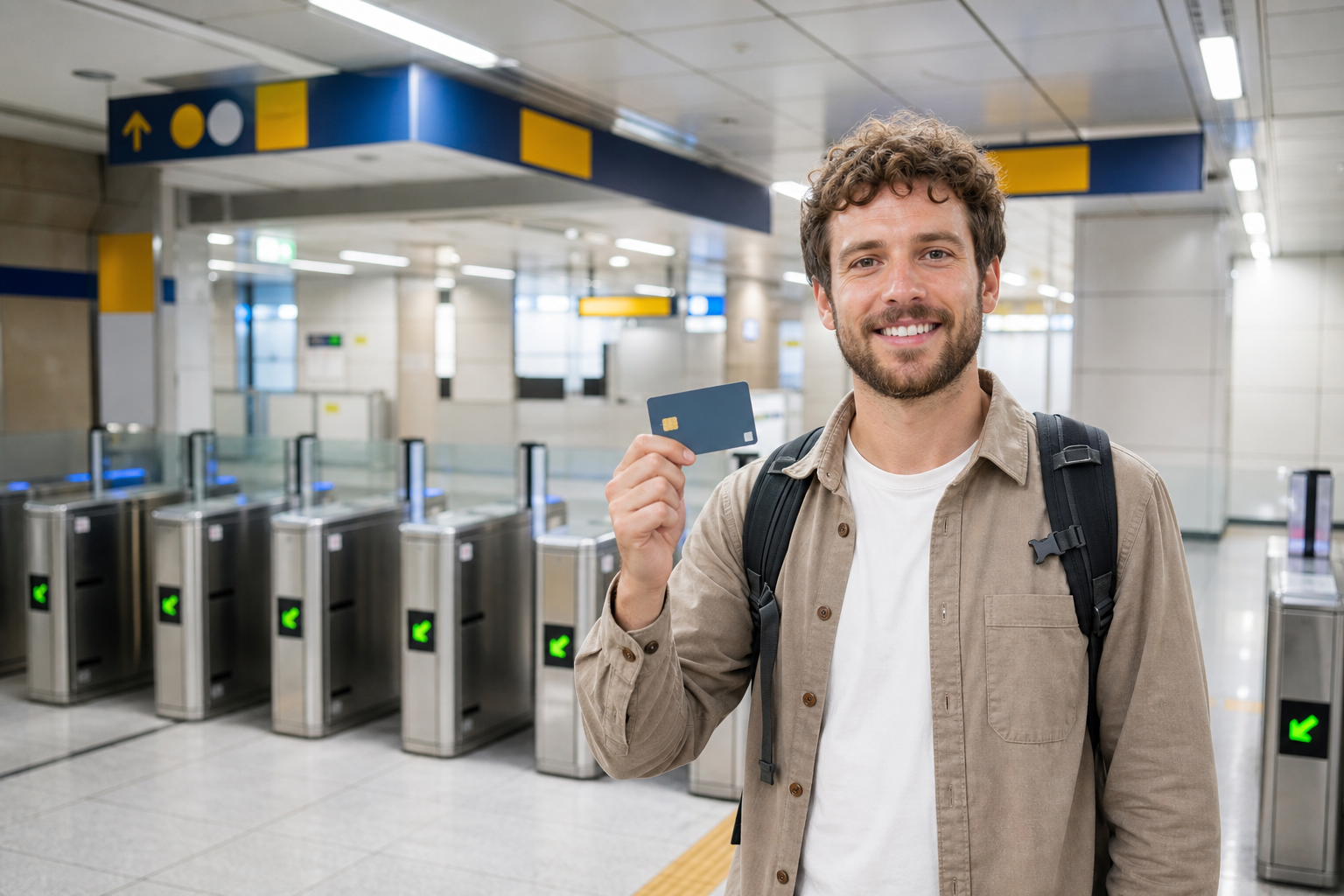
    Traveler organizing cards and Korean won cash for a South Korea trip

    Do not carry your entire travel budget in cash. Split emergency money between your wallet and a secure bag or hotel safe. Smaller notes are more convenient for markets and machines than a wallet filled only with ₩50,000 bills.

    5. Using ATMs in South Korea

    Look for an ATM marked “Global ATM” or one displaying your card network. Machines at major airports, banks, convenience stores, subway stations, and busy shopping areas often provide an English menu. Acceptance still varies by machine and card issuer.
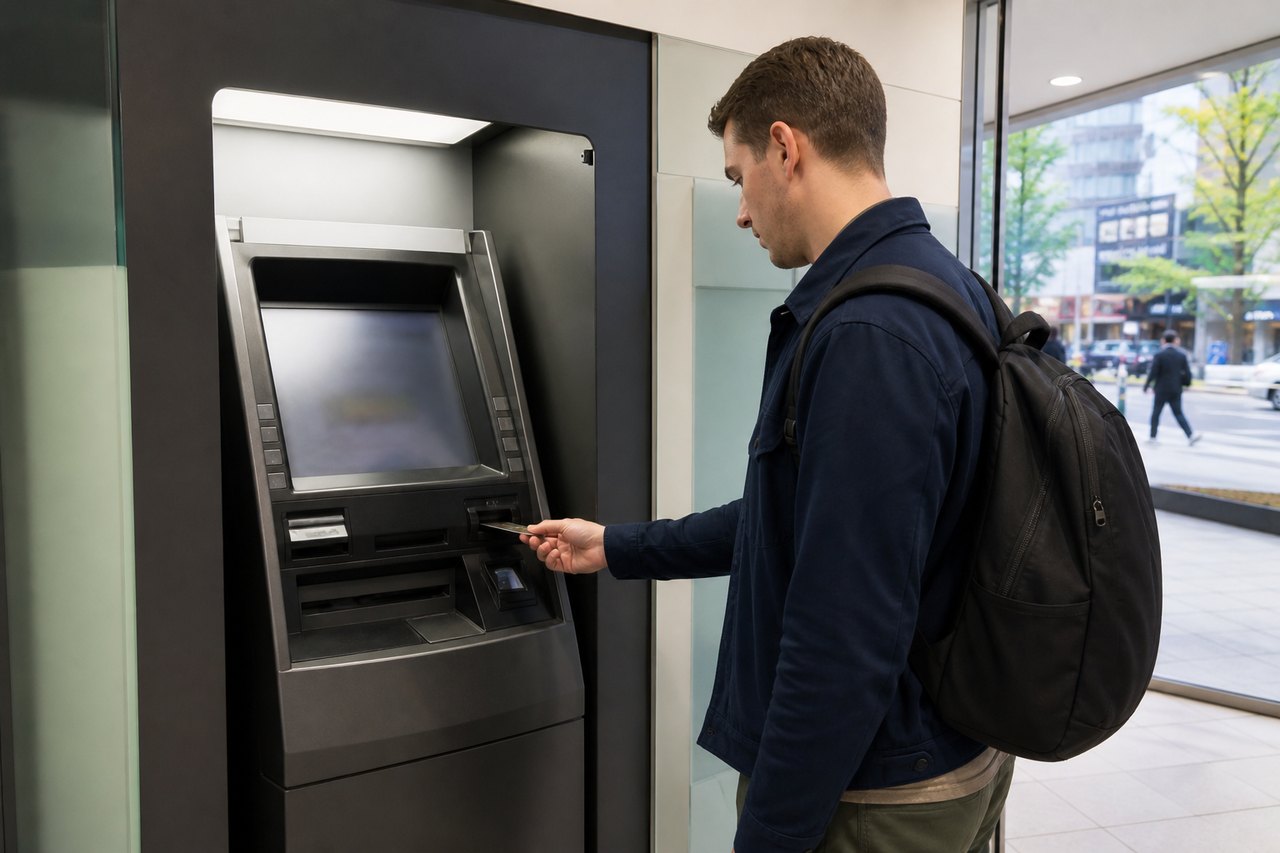
    International traveler using a global ATM in Seoul
    • Select English before starting the transaction.
    • Choose an international or foreign-card option when shown.
    • Withdraw from a machine in a well-lit public location.
    • Shield the keypad while entering your PIN.
    • Take your card, cash, and receipt before walking away.

    If one ATM rejects your card, try a machine from another bank rather than assuming the card cannot be used in Korea. Some international debit cards work at one ATM network but not another.

    6. ATM Fees and Dynamic Currency Conversion

    An ATM withdrawal may include a local operator fee, your home bank’s withdrawal fee, and a currency-conversion cost. The exact amount depends on the machine and your bank, so review the fee screen before confirming.

    If an ATM or card terminal offers to charge you in your home currency, this is usually dynamic currency conversion. The displayed amount can feel reassuring, but the exchange rate may be less favorable. In most cases, choose to pay or withdraw in Korean won and let your card issuer perform the conversion.

    Do not make many tiny withdrawals unless necessary. Fewer, sensible withdrawals can reduce repeated fixed fees, but avoid taking more cash than you can store securely.

    7. Where to Exchange Money

    Airport exchange counters are convenient when you need won immediately after landing. Rates in the city may be more competitive, so you can exchange a small arrival amount first and handle the rest later.

    • Use a bank or government-authorized exchange booth.
    • Compare the final amount after commission, not only the advertised rate.
    • Bring your passport because identification may be required.
    • Avoid unlicensed street exchange offers.
    • Keep the receipt until you have checked the cash.

    Bank hours and exchange-counter hours vary by location. If you arrive late, confirm airport operating hours in advance. Our Incheon Airport to Seoul guide will help you plan the next part of your arrival.

    8. Paying for Transportation

    For subways and city buses, a rechargeable transportation card is usually easier than buying individual tickets. A T-money or similar card can be purchased at convenience stores and many stations, then tapped when entering and leaving the system.

    Keep cash available for top-ups because many standard transit-card machines and convenience stores do not accept foreign cards for reloading. Some tourist-focused prepaid products offer additional loading methods, but fees and conditions differ.

    Read our complete T-money card guide and South Korea public transportation guide before your first subway or bus trip. The official VISITKOREA transportation-card guide also compares current tourist options.

    9. Mobile Payments and Prepaid Travel Cards

    Korea has an advanced mobile-payment ecosystem, but many domestic services are designed around Korean bank accounts, phone numbers, or identity verification. A mobile wallet that works at home may not work at every Korean terminal.

    Foreigner-focused prepaid cards can be useful for travelers who want to load a fixed budget and monitor spending in an app. Compare issuance fees, exchange rates, withdrawal rules, refund procedures, supported currencies, and transportation functions before choosing one.

    Never rely only on your phone for payment. A dead battery, lost connection, or unsupported terminal can leave you stuck. Keep a physical card and a little cash as backup. For reliable connectivity, see our South Korea SIM card, eSIM, and pocket WiFi comparison.

    10. Tipping in South Korea

    Tipping is not a standard Korean custom. Restaurant servers, café staff, taxi drivers, and most hotel employees do not expect a percentage tip. Pay the amount shown unless a service charge is clearly included.

    In some upscale hotels or restaurants, a service charge may already appear on the bill. Offering extra cash can create confusion, so do not feel obligated. A polite thank-you is appropriate.

    The Official Seoul tourism money guide also states that tipping is not expected, while noting that some major hotels and upscale restaurants add a service charge.

    11. A Simple Money Plan for Your Korea Trip

    1. Before departure: Check international fees, ATM limits, PINs, and fraud-alert settings for two cards.
    2. On arrival: Obtain a modest amount of Korean won at the airport or an international ATM.
    3. For daily spending: Use your best no-foreign-transaction-fee card where accepted.
    4. For transportation: Keep enough cash to buy and reload a transit card.
    5. For emergencies: Store one backup card and some cash separately from your main wallet.
    6. Before leaving: Spend small coins and notes or exchange eligible remaining cash at an authorized counter.

    12. Common Money Mistakes to Avoid

    • Traveling with only one card.
    • Assuming every ATM accepts every foreign card.
    • Accepting home-currency conversion without comparing the rate.
    • Carrying no cash for transit top-ups or small vendors.
    • Exchanging all your money at the first counter without checking fees.
    • Keeping all cards and cash in one wallet.
    • Depending entirely on a mobile-payment app.
    • Offering tips automatically when none are expected.

    Frequently Asked Questions

    Can I travel in South Korea without cash?

    You can pay by card in most tourist-facing businesses, but traveling with no cash is inconvenient. Keep some won for transit-card top-ups, markets, small vendors, and payment-system problems.

    Will my foreign Visa or Mastercard work in Korea?

    Usually, yes. Major international cards are widely accepted, but an individual merchant or machine may decline one. Bring a backup card and confirm international use with your bank.

    Should I exchange money before arriving?

    You do not need to exchange your entire budget before departure. Having a small amount of won for arrival can be convenient, while airport counters and international ATMs provide other options.

    Do I tip in Korean restaurants or taxis?

    No tip is normally expected. Pay the listed fare or bill unless a service charge is clearly shown.

    Final Thoughts

    The best payment strategy in South Korea is a flexible one. Use cards for most purchases, keep Korean won for cash-only situations, and carry a backup payment method in a separate place.

    Before every ATM withdrawal or card payment, check the currency, fees, and final amount. A few minutes of preparation can prevent most payment problems and help you enjoy Korea with confidence.
  • South Korea SIM Card vs eSIM vs Pocket WiFi: Which Is Best?

    South Korea SIM Card vs eSIM vs Pocket WiFi: Which Is Best?

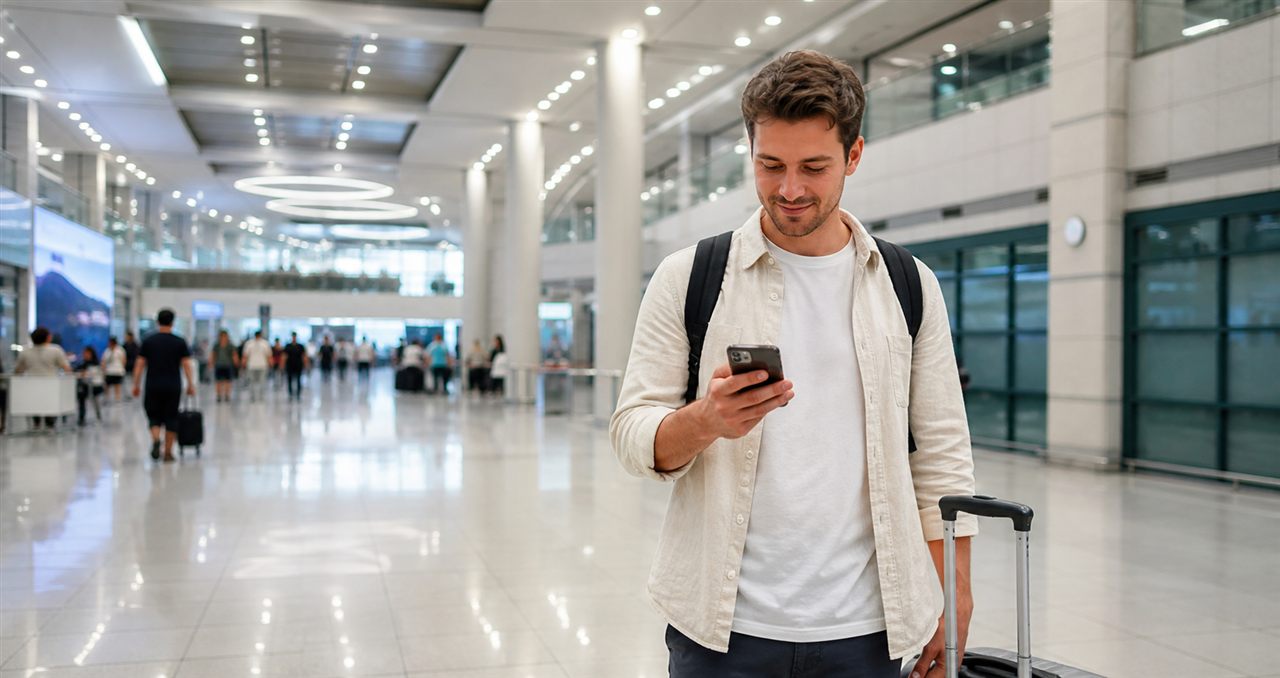
    A South Korea SIM card, eSIM, or pocket WiFi can keep you connected from the moment you arrive.

    Reliable mobile data is extremely useful in Korea. You will need it for Naver Map or KakaoMap, subway directions, translation, restaurant searches, booking confirmations, and communication with your accommodation.

    The best choice depends on your phone, trip length, group size, need for a Korean phone number, and willingness to carry an extra device. This guide compares the three main options and explains what first-time visitors should check before buying.

    For more preparation advice, read our South Korea travel tips for first-time visitors.

    Table of Contents

    1. SIM Card vs eSIM vs Pocket WiFi: Quick Comparison

    OptionBest ForMain AdvantageMain Limitation
    eSIMSolo travelers with compatible phonesNo physical pickup or SIM swapNot supported by every phone
    Physical SIMTravelers needing a simple local connectionWidely available with staff supportYou must remove or manage your original SIM
    Pocket WiFiFamilies and small groupsConnects several devicesExtra device to charge, carry, and return

    For most solo travelers, an eSIM is the most convenient choice if the phone supports it. A physical SIM is useful when you want in-person setup assistance. Pocket WiFi can offer good value when several people stay together throughout the day.

    2. What to Check Before Buying

    Do not purchase a plan until you have checked these details:

    • Phone lock status: Your phone must be carrier-unlocked to use another provider’s SIM or eSIM.
    • eSIM compatibility: Confirm the exact phone model, not only the product family.
    • Trip duration: Choose a validity period that covers your arrival and departure days.
    • Data-only or voice service: Some tourist plans provide data but no Korean phone number.
    • Activation timing: A plan may begin when installed, when connected in Korea, or on a selected date.
    • Hotspot allowance: Tethering rules can differ between plans.
    • Refund conditions: Digital products may become non-refundable after purchase or activation.

    If you are unsure whether your phone is unlocked, contact your home carrier before leaving. Airport staff in Korea cannot remove a lock placed by your original carrier.

    3. Using an eSIM in South Korea

    An eSIM is a digital SIM profile installed on a compatible phone. The provider normally sends a QR code or activation instructions by email, so there is no plastic card to collect.

    The main advantage is convenience. You can prepare the plan before flying, keep your physical SIM in the phone, and switch on the Korean data line after arrival.

    • Best for: Solo travelers, short trips, and visitors who want immediate mobile data.
    • Good to know: Many travel eSIMs are data-only and may not include a local number for calls or SMS.
    • Important: Save the QR code and instructions somewhere accessible without internet.
    Traveler installing a Korea eSIM by scanning a QR code on a smartphone

    Some phones allow two lines to remain active, which can help you receive messages on your home number while using the Korean eSIM for data. However, your home carrier may still charge for calls, messages, or roaming activity.

    4. Using a Physical SIM Card in Korea

    A physical prepaid SIM replaces or sits alongside your current SIM, depending on whether your phone has one or two SIM slots.

    Major airport roaming counters and selected convenience stores sell tourist SIM cards. Buying from a staffed counter can be reassuring because the staff can confirm compatibility and help with installation or activation.

    • Best for: Travelers whose phones do not support eSIM or who want setup help.
    • Possible benefit: Some plans include a Korean phone number, voice calls, or SMS.
    • Remember: Store your original SIM safely if you remove it.

    Tourist plans and identity-verification requirements vary. A provider may require your passport or confirmation of entry before enabling certain voice and messaging services.

    5. Using Pocket WiFi in Korea

    Pocket WiFi is a small portable router that connects to the mobile network and creates a private WiFi signal for your devices.

    It can be a practical option for couples, families, or friends who stay together. Several phones and tablets can connect to one router, so the daily cost may be reasonable when shared.

    • Everyone must remain close to the router.
    • The device needs regular charging.
    • You must carry the router and usually a charging cable or power bank.
    • Rental equipment must be returned at the correct location and time.
    • Loss, damage, or late return may create additional charges.
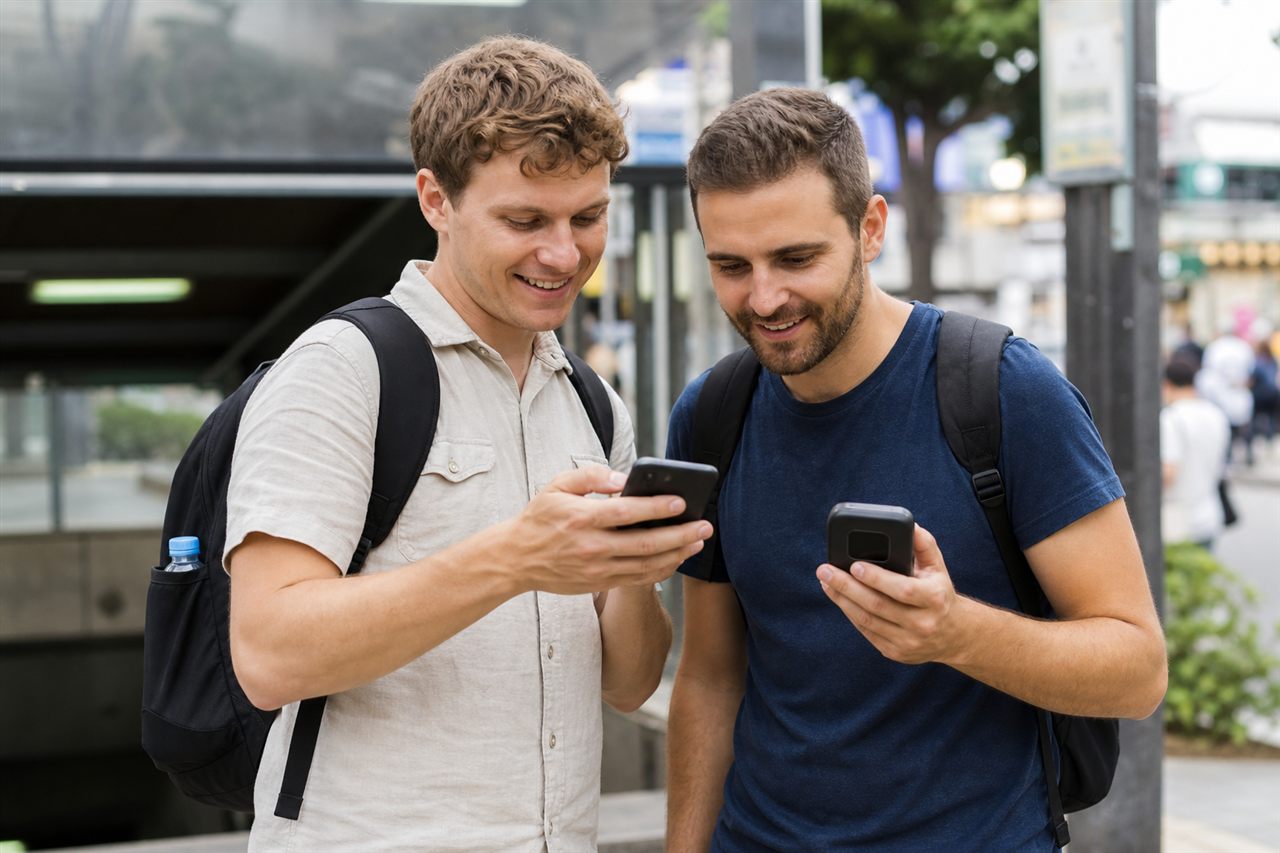
    Two international travelers sharing a pocket WiFi router while navigating Seoul

    Pocket WiFi is less convenient when group members split up. The person carrying the router keeps the connection, while everyone else may lose internet access.

    6. Do You Need a Korean Phone Number?

    Many travelers only need mobile data. Navigation apps, email, internet messaging, and most travel information work without a Korean phone number.

    A local number may help when a hotel, tour company, restaurant, or delivery service needs to contact you. However, having a number does not guarantee access to every Korean online service. Some apps require a resident identity check or a verified long-term mobile account.

    Read the plan details carefully. “Unlimited data” does not automatically mean that local calls, outgoing SMS, or identity verification are included.

    7. Where to Buy a SIM or Rent WiFi at Incheon Airport

    Incheon International Airport has roaming centers and communication-service counters in both passenger terminals. Major Korean carriers and WiFi rental companies operate airport locations, but hours and exact counters can change.

    Use the official Incheon Airport facilities directory to confirm the current terminal, floor, counter location, and operating hours.

    If you reserve online, check the pickup terminal carefully. Terminal 1 and Terminal 2 are separate, and traveling to the wrong terminal wastes time after a long flight.

    Once connected, our Incheon Airport to Seoul transportation guide will help you choose between the airport train, bus, and taxi.

    8. How to Prepare Your Phone Before Arrival

    1. Confirm that the phone is unlocked.
    2. Update the operating system before traveling.
    3. Check eSIM or SIM compatibility for the exact model.
    4. Save the provider’s setup instructions offline.
    5. Download Naver Map, KakaoMap, and a translation app.
    6. Save your accommodation address in Korean.
    7. Keep your provider order number and support contact details.

    Install an eSIM according to the provider’s instructions. Do not assume it is safe to activate immediately: some plans start their validity period at installation, while others begin only after connecting to a supported Korean network.

    9. How Much Data Do You Need?

    Light users mainly need data for maps, messaging, searches, and booking details. Heavy users may stream video, upload large photo collections, join video calls, or use a laptop through a hotspot.

    • Light use: Maps, messaging, email, and occasional browsing.
    • Moderate use: Frequent social media, photo uploads, and short videos.
    • Heavy use: Streaming, video calls, cloud backups, and laptop tethering.

    “Unlimited” plans may reduce speed after a daily or total high-speed allowance. Check both the high-speed data amount and the reduced speed instead of relying on the word unlimited alone.

    10. How to Avoid Unexpected Roaming Charges

    If you keep your home SIM active, disable data roaming on that line and select the Korean SIM or eSIM as the mobile-data line. Settings differ by phone, so review your device instructions before travel.

    • Turn off mobile-data switching if you do not want the phone to fall back to your home line.
    • Check which line is used for calls and messages.
    • Be careful when answering calls on your home number.
    • Disable automatic cloud backups over mobile data if your plan is limited.
    • Take screenshots of the working settings after setup.

    Public WiFi is widely available in airports, stations, hotels, cafés, and other busy locations, but it should be treated as a backup rather than your only connection. Coverage and login requirements vary, especially outside major city centers.

    The official VISITKOREA communications guide provides current general information on roaming centers, SIM cards, eSIMs, and internet access.

    11. Common Mistakes to Avoid

    • Buying before checking phone compatibility: Confirm the exact model and lock status.
    • Activating too early: Read when the validity period begins.
    • Assuming data-only includes calls: Check whether a Korean number, voice, and SMS are provided.
    • Losing the original SIM: Store it in a small labeled container.
    • Leaving home-line roaming active: Select the correct data line after arrival.
    • Forgetting the pocket WiFi return: Confirm the terminal and deadline.
    • Depending only on public WiFi: It may not be available when you need navigation most.
    • Buying more data than necessary: Choose based on realistic daily use.

    Frequently Asked Questions

    Is eSIM better than a SIM card for Korea?

    An eSIM is often more convenient for a compatible unlocked phone. A physical SIM may be better when your phone lacks eSIM support or you want airport staff to help with setup.

    Can I buy a SIM card after arriving at Incheon Airport?

    Yes. Carrier roaming centers and selected shops sell tourist SIM products at the airport. Check current terminal locations and operating hours before your flight.

    Can I keep my normal phone number while using an eSIM?

    Many dual-SIM phones allow both lines to remain installed, but support varies. Receiving or making calls through the home line may still trigger carrier charges.

    Is pocket WiFi worth it for one person?

    It can work well, but most solo travelers find an eSIM or physical SIM easier because there is no extra router to charge, carry, and return.

    Final Thoughts

    Choose an eSIM for maximum convenience, a physical SIM for broad compatibility and in-person help, or pocket WiFi when several travelers will share one connection.

    Whichever option you select, confirm compatibility, activation timing, data limits, phone-number availability, and refund conditions before paying.

    Mobile data makes Korean navigation much easier. See our South Korea public transportation guide for subway, bus, and navigation-app tips.

  • Incheon Airport to Seoul: Best Transportation Options for First-Time Visitors

    Incheon Airport to Seoul: Best Transportation Options for First-Time Visitors

    Traveling from Incheon Airport to Seoul is straightforward once you know which option fits your destination, arrival time, luggage, and budget.

    Most first-time visitors choose between the Airport Railroad Express (AREX), an airport limousine bus, or a taxi. Each option has a clear advantage: the train is predictable, the bus can reduce transfers, and a taxi provides door-to-door convenience.

    This guide compares the main ways to travel from Incheon Airport to Seoul and explains how to choose the best one for areas such as Hongdae, Myeongdong, Seoul Station, and Gangnam.

    Before you travel, see our South Korea travel tips for first-time visitors for essential advice on mobile internet, navigation, money, and local etiquette.

    Table of Contents

    1. Incheon Airport to Seoul: Quick Comparison

    OptionBest ForTypical TimeMain Advantage
    AREX ExpressSeoul StationAbout 43–51 minutesFast, reserved seat, no traffic
    AREX All-StopHongdae, Gongdeok, budget travelAbout 59–66 minutes to Seoul StationAffordable and frequent
    Airport BusMyeongdong, hotels, fewer transfersAbout 60–90+ minutesLuggage storage and many routes
    TaxiGroups, heavy luggage, late arrivalAbout 60–100+ minutesDoor-to-door service

    Travel times can be longer during rush hour, bad weather, or heavy road traffic. Train times are generally more predictable, while buses and taxis depend on road conditions.

    2. What to Do Before Leaving the Airport

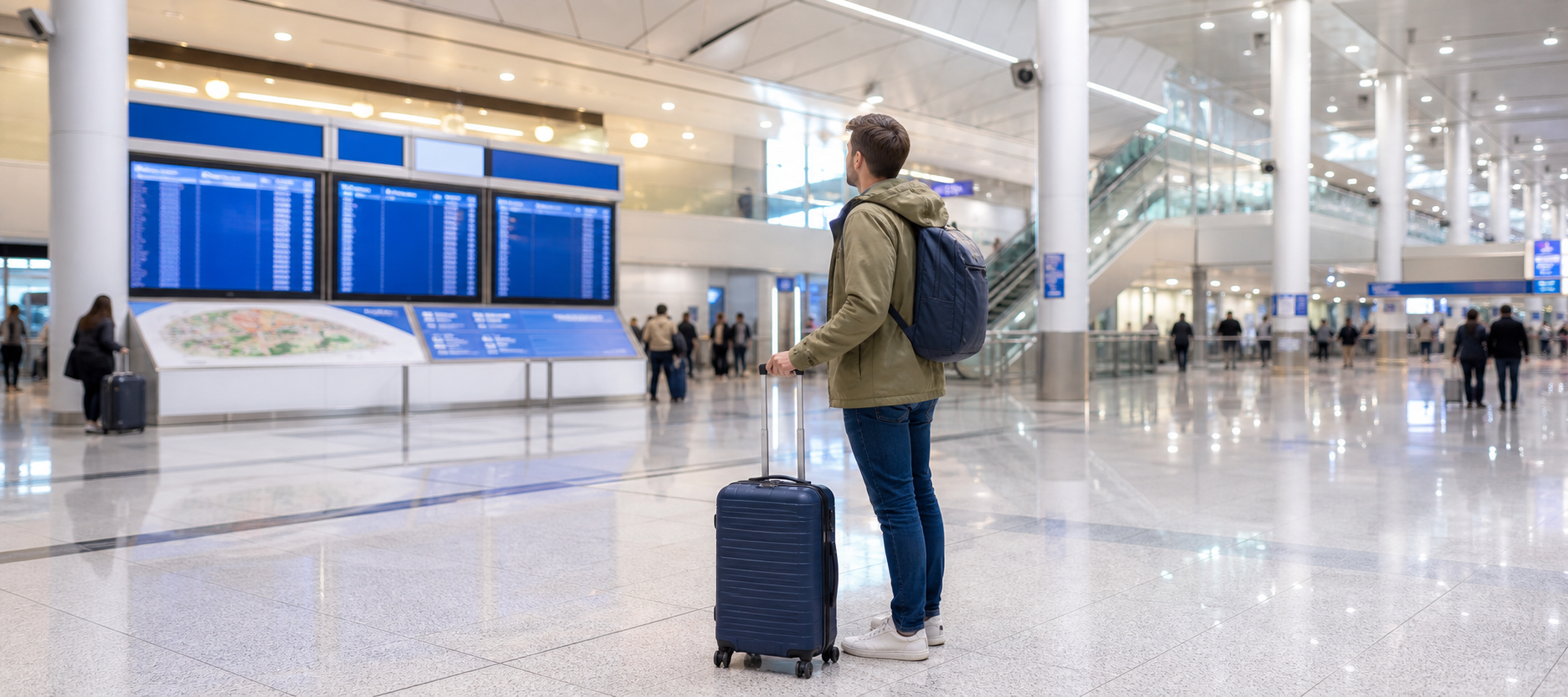
    Before choosing transportation, confirm whether you arrived at Terminal 1 or Terminal 2. Both terminals have train, bus, and taxi access, but the station entrances and boarding locations are different.

    It also helps to prepare the following:

    • your hotel name and full address
    • the address written in Korean
    • a local navigation app such as Naver Map or KakaoMap
    • mobile internet access
    • a payment card and some Korean won
    • the nearest subway station and exit to your accommodation

    If you plan to use the all-stop train or continue by subway, a rechargeable transportation card is useful. Our T-money card guide explains where to buy and recharge one at the airport.

    3. AREX Express Train

    The AREX Express Train runs non-stop between Incheon International Airport and Seoul Station. It is a strong choice when your hotel is near Seoul Station or when you plan to transfer to another train from there.

    According to current Seoul city information, the trip takes about 43 minutes from Terminal 1 and 51 minutes from Terminal 2. The listed one-way adult fare is 13,000 won, but fares and promotions can change.

    Express Train tickets are separate from ordinary subway travel. Purchase the correct ticket at an AREX Express ticket booth or machine rather than tapping through the all-stop train gate by mistake.

    • Choose it if: You want a reserved seat, predictable travel time, and a direct ride to Seoul Station.
    • Avoid it if: Your destination is Hongdae or another stop served directly by the all-stop train, because traveling through Seoul Station may create an unnecessary transfer.
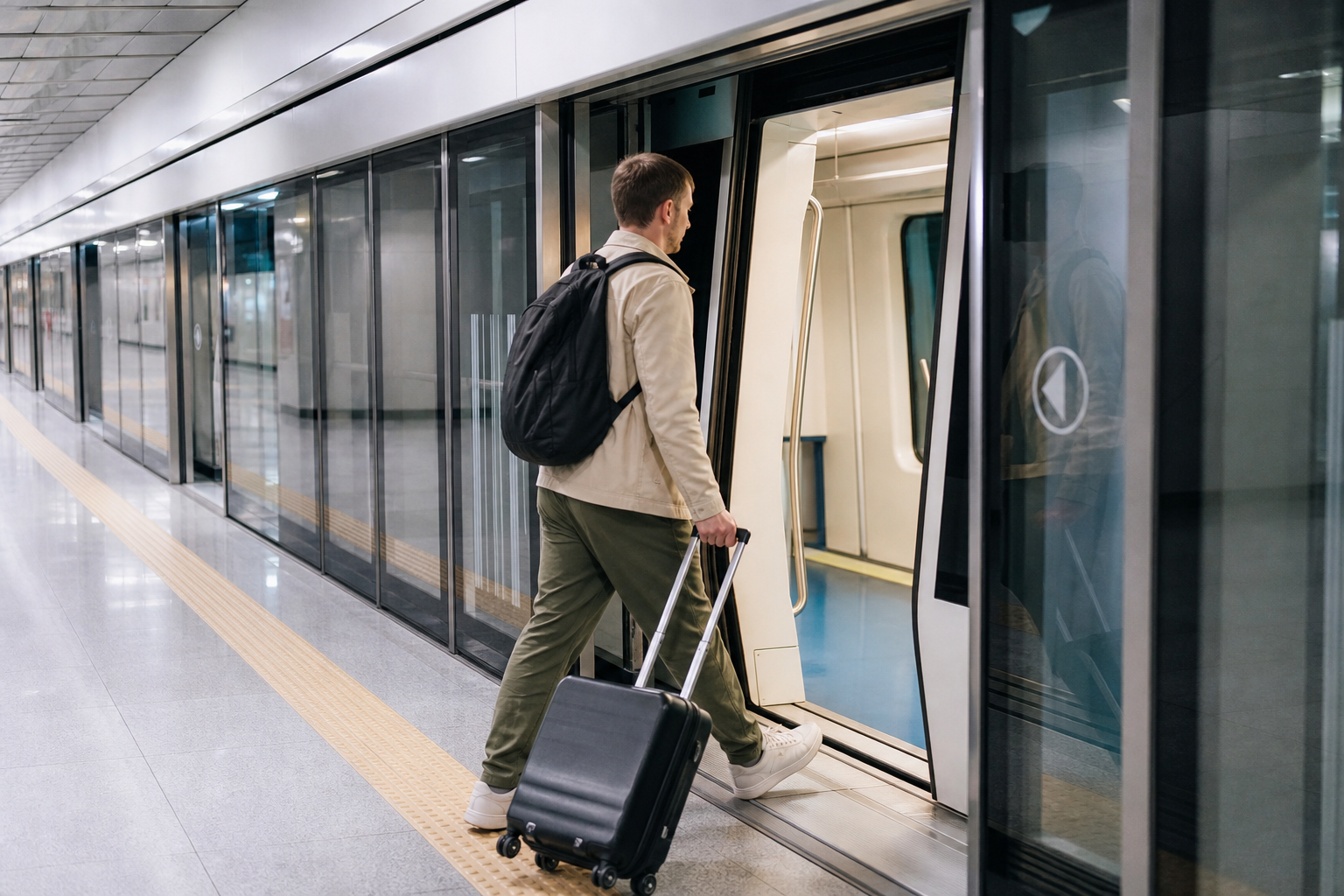
    International traveler boarding an airport railroad train at Incheon Airport

    4. AREX All-Stop Train

    The AREX All-Stop Train is usually the most affordable rail option. It stops at several useful stations, including Gimpo International Airport, Digital Media City, Hongik University, Gongdeok, and Seoul Station.

    The journey to Seoul Station takes roughly 59 minutes from Terminal 1 and 66 minutes from Terminal 2. The published fare is generally around 4,150 to 4,750 won depending on your starting terminal and destination.

    This train uses the regular metropolitan transit system. You can normally travel with a compatible transportation card or buy a single-use ticket.

    • Best for Hongdae: Get off at Hongik University Station without traveling to Seoul Station.
    • Best for Gongdeok: The direct stop can reduce transfers for nearby accommodations.
    • Best for budget travelers: It is inexpensive and operates frequently.

    The all-stop train has standard subway-style seating, so a seat is not guaranteed. It can also become crowded during commuting hours.

    5. Airport Limousine Bus

    Airport limousine buses connect both terminals with major districts, hotels, and tourist areas across Seoul. They are especially useful when the bus stops close to your accommodation.

    Large luggage is stored in the compartment under the bus, which makes the ride more comfortable than carrying suitcases through subway stations. Keep the baggage claim tag that the staff gives you.

    Official Seoul information lists journey times of approximately 60 to 80 minutes, but traffic can extend the trip. Fares vary by route and operator, so check the route display and current price at the airport ticket counter.

    • Confirm the bus number and destination before buying a ticket.
    • Check whether the stop is within walking distance of your hotel.
    • Allow extra time during weekday rush hour.
    • Listen for announcements and follow your route on a navigation app.
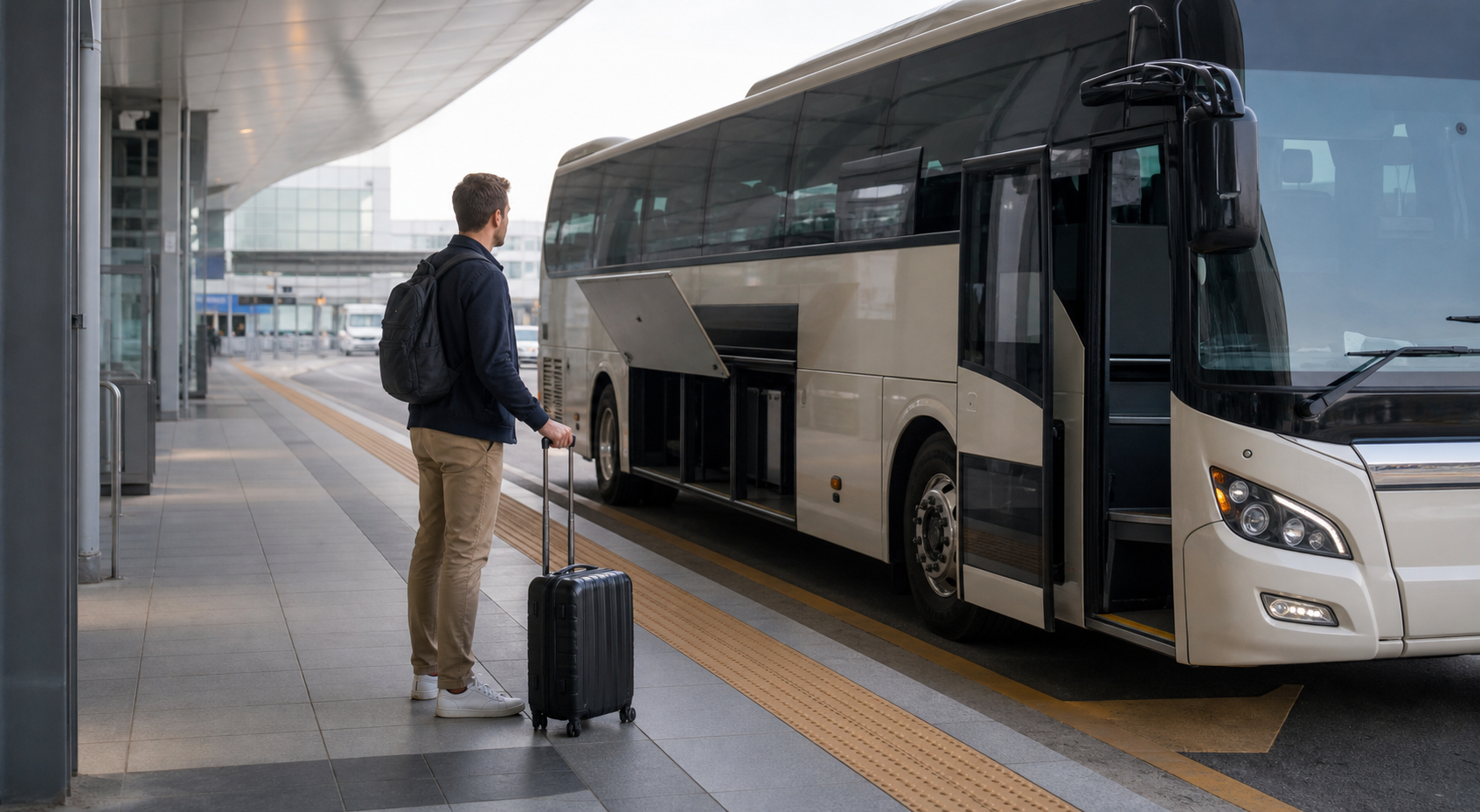
    International traveler waiting to board an airport limousine bus at Incheon Airport

    Use the official Incheon International Airport website to check current bus routes, boarding locations, and operating information.

    6. Taxi from Incheon Airport to Seoul

    A taxi is the easiest door-to-door option, especially for two or more travelers sharing the fare, families with children, people with mobility needs, or anyone carrying several bags.

    The total cost varies significantly by destination, traffic, taxi type, and time of day. A trip to central Seoul often takes 60 to 100 minutes or more. Road tolls and late-night surcharges may be added.

    Use only an official taxi from a designated airport taxi stand. Incheon Airport specifically warns travelers about illegal solicitation and possible overcharging by unauthorized drivers or call vans.

    • Ignore people approaching you inside the terminal to offer an unofficial ride.
    • Follow airport signs to the official taxi queue.
    • Show the driver your destination in Korean.
    • Confirm whether tolls and surcharges are included in any quoted price.
    • Keep the receipt after payment.

    Check the current pickup zones and surcharge rules on the official Incheon Airport taxi guide.

    7. Private Airport Transfer

    A pre-booked private transfer can be convenient for large groups, travelers arriving with special equipment, or anyone who wants a driver waiting after arrival.

    Before booking, check the cancellation policy, waiting-time allowance, vehicle size, baggage limit, meeting point, and whether tolls are included. Use an established provider and keep the booking confirmation available offline.

    8. Best Option by Seoul Area

    Hongdae

    The AREX All-Stop Train is often the simplest choice because it stops directly at Hongik University Station. Check the correct exit because the station is large.

    Seoul Station

    The AREX Express is the fastest direct rail option, while the all-stop train is the cheaper choice. Select based on your budget, luggage, and departure time.

    Myeongdong

    An airport limousine bus may be easiest if it stops near your hotel. The train is also practical, but it usually requires a transfer or a short taxi ride from Seoul Station.

    Gangnam

    A direct airport bus can reduce the inconvenience of carrying luggage through multiple transfers. A taxi is comfortable for groups, although traffic can make the journey slow and expensive.

    9. What If You Arrive Late at Night?

    Public transportation does not operate all night. If immigration and baggage collection take longer than expected, you may miss your preferred train or bus.

    Check the final departure time for your arrival terminal on the day you travel. Late-night airport buses may operate on limited routes, while taxis remain available but can include a night surcharge.

    If your flight lands very late, compare the cost of a taxi with staying near the airport and traveling into Seoul the next morning.

    10. Traveling with Luggage

    The fastest option is not always the easiest option when you have heavy luggage.

    • One small suitcase: Either AREX train is usually manageable.
    • Several large bags: Consider an airport bus, taxi, or private transfer.
    • A hotel beside a bus stop: The airport bus may save a difficult subway transfer.
    • A hotel near Hongik University or Seoul Station: The train is often convenient.

    Avoid blocking train doors and escalators. Use elevators when available, keep bags close, and allow other passengers to exit before boarding.

    11. Common Mistakes to Avoid

    • Going to the wrong train gate: The Express and All-Stop trains use different ticketing arrangements.
    • Traveling to Seoul Station unnecessarily: Hongdae travelers can use the direct all-stop train.
    • Choosing a bus without checking the final stop: Confirm the walking distance to your hotel.
    • Ignoring rush-hour traffic: Road travel can take much longer than expected.
    • Accepting an unofficial taxi offer: Use the designated airport taxi stand.
    • Not checking the last departure: Schedules vary by terminal and day.
    • Forgetting your terminal: Terminal 1 and Terminal 2 are separate, so follow the signs for your actual arrival terminal.

    Frequently Asked Questions

    What is the cheapest way from Incheon Airport to Seoul?

    The AREX All-Stop Train is usually the cheapest practical option for central Seoul. Your exact fare depends on the destination and terminal.

    What is the fastest way to Seoul Station?

    The AREX Express Train is normally the fastest scheduled option because it runs non-stop and is not affected by road traffic.

    Can I use T-money on the AREX train?

    You can generally use a compatible transportation card on the AREX All-Stop Train. The Express Train requires its own ticket.

    Should I take a bus or train to Myeongdong?

    A direct airport bus is often easier with luggage if it stops near your hotel. The train can be faster during heavy traffic but usually requires a transfer or an additional ride.

    Final Thoughts

    For most first-time visitors, the best transportation choice depends more on the hotel location than on a single “best” route.

    Choose the AREX Express for a quick ride to Seoul Station, the all-stop train for Hongdae or budget travel, an airport bus for fewer transfers, and a taxi for door-to-door convenience.

    Once you arrive in the city, use our South Korea public transportation guide to navigate subways and buses with confidence.

  • T-money Card in Korea: A Complete Guide for First-Time Visitors

    T-money Card in Korea: A Complete Guide for First-Time Visitors

    A T-money card in Korea is one of the easiest ways to use public transportation in South Korea.

    Instead of buying a separate ticket for every subway or bus ride, you can load money onto the card and tap it whenever you travel. It works across much of the country and can also be used at selected stores and other participating locations.

    This beginner-friendly guide explains where to buy a T-money card, how much it costs, how to recharge it, how to use it on subways and buses, and what to do with the remaining balance before you leave Korea.

    New to Korea’s transport system? Read our South Korea public transportation guide for a complete overview of subways, buses, fares, and navigation apps.

    Table of Contents

    1. What Is a T-money Card?

    T-money is a rechargeable prepaid transportation card. You add a balance to the card before traveling and tap it on a card reader when entering and leaving the transport system.

    For most first-time visitors, a standard physical card is the simplest option. It does not require a Korean bank account, and a regular card can generally be purchased without registration or identification.

    The plastic card and the stored balance are separate costs. Buying the card gives you the card itself; you must then add money before your first ride.

    2. Where Can You Use a T-money Card?

    T-money can be used on most public transportation networks in South Korea, including many:

    • city subways
    • city and local buses
    • airport transportation services that display the T-money logo
    • taxis with compatible card readers
    • selected intercity and express transport services

    The card can also be used at participating convenience stores, vending machines, and other businesses displaying the T-money logo. Acceptance can vary, so look for the logo or ask the cashier before paying.

    3. Where to Buy a T-money Card

    The easiest place to buy a card is usually a convenience store. Major chains such as CU, GS25, and 7-Eleven commonly sell transportation cards, although stock and designs vary by location.

    You may also find cards at subway station information centers and selected ticket machines. At Incheon International Airport, check convenience stores and transportation-card vending machines in the arrival area.

    Say “T-money card, please” and tell the cashier how much you want to add. The cashier can often sell and recharge the card in one transaction.

    4. How Much Does a T-money Card Cost?

    A standard card generally costs about 3,000 to 5,000 Korean won. Special character designs and tourist versions can cost more.

    The purchase price is normally not part of your usable balance and is generally not refundable. For example, if a card costs 4,000 won and you want 30,000 won available for travel, you will pay about 34,000 won in total.

    Prices and available card types can change. Check the current details on the official VISITKOREA transportation card guide before your trip.

    5. How to Recharge a T-money Card

    You can recharge the card at many convenience stores and subway ticket machines.

    • At a convenience store: Hand the card to the cashier, state the amount, and pay for the recharge.
    • At a subway station: Use a compatible recharge machine, select an available language, place the card on the reader, choose the amount, and insert payment.

    Cash remains the most reliable payment method for visitors. Some machines or services may support other payment methods, but foreign-issued cards are not accepted everywhere. Keep a few Korean won banknotes available for recharging.

    International traveler recharging a transit card at a Seoul subway ticket machine

    6. How Much Money Should You Load?

    For a short trip, starting with 20,000 to 40,000 won is practical for many travelers. The right amount depends on how long you are staying, how many rides you take, and whether you travel outside Seoul.

    A cautious approach is to start with a moderate balance and add more later. Convenience stores and subway stations are common, so there is usually no reason to load a very large amount at once.

    7. How to Use T-money on the Subway

    Using the card on the subway is simple:

    1. Find the correct subway line and direction.
    2. Place the card flat on the reader at the entrance gate.
    3. Wait for the confirmation sound or light.
    4. Enter through the gate and keep the card with you.
    5. Tap the same card again at the exit gate.

    The display usually shows the fare charged and the remaining balance. If the gate does not open, do not force it. Try tapping again slowly or ask station staff for help.

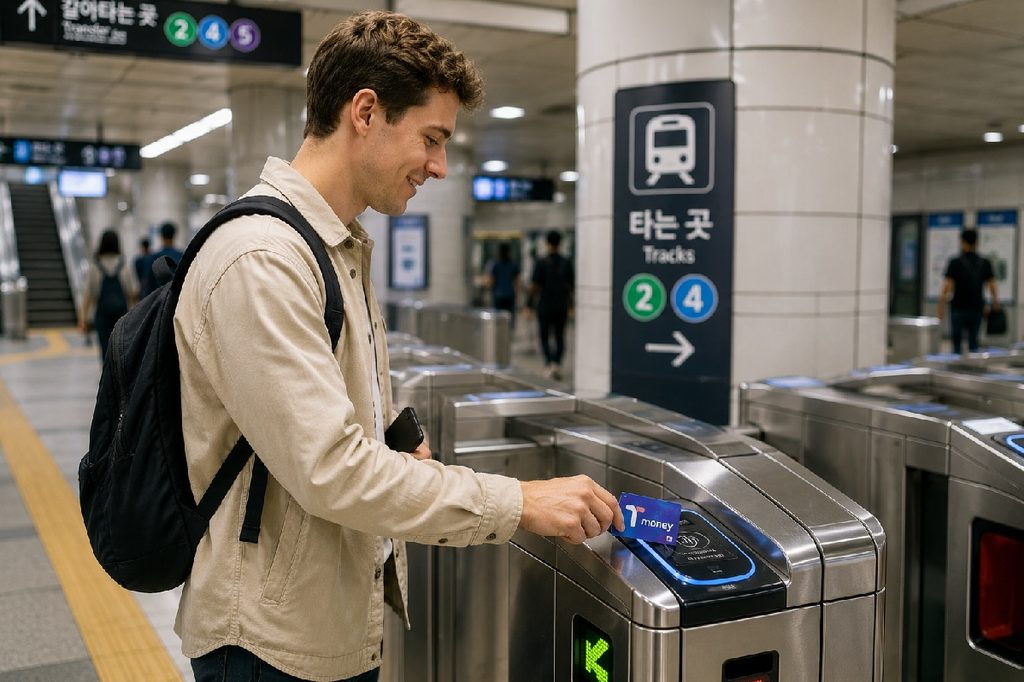
    International traveler tapping a transit card at a Seoul subway gate

    8. How to Use T-money on a Bus

    On most city buses, board through the front door and tap the card on the reader near the driver. A sound and screen message confirm the payment.

    Before your stop, press a stop button. When leaving, tap the card again on the reader near the rear door. Tapping when you exit is important because it records the distance traveled and may be required for transfer discounts.

    9. Transfers and Fare Discounts

    One of the main advantages of using a transportation card is the integrated transfer system. Depending on the city, route, and transfer timing, you may receive a discounted or included transfer between buses and subways.

    Always tap when entering and exiting. If you forget to tap out on a bus, the system may not apply the correct transfer benefit, and a later fare calculation may be affected.

    10. How to Check Your T-money Balance

    The remaining balance normally appears briefly on the reader whenever you tap. You can also ask a convenience-store cashier to check it or place the card on a compatible subway recharge machine.

    Check the balance before a long journey or airport transfer. If the balance is too low when you exit the subway, use a fare-adjustment machine or ask station staff for assistance.

    11. Refunding the Remaining Balance

    Small remaining balances can often be refunded at participating convenience stores or service locations. A service fee may be deducted, and the original card purchase price is generally not returned.

    According to current official tourism information, refunds above 50,000 won require a visit to Tmoney Town near Seoul Station. Rules and eligible locations can change, so confirm the latest refund details before departure.

    For a very small balance, the easiest option may be to spend it at a participating convenience store. The official T-money travel card page provides current information for international visitors.

    12. Common Mistakes to Avoid

    • Forgetting to recharge: Check the balance before entering a station or boarding a bus.
    • Using different cards during one trip: Each traveler should use the same individual card when entering and exiting.
    • Forgetting to tap off a bus: This can affect transfer discounts and fare calculations.
    • Loading too much money: Start with a moderate amount and recharge when necessary.
    • Assuming every machine accepts foreign cards: Carry cash for the most reliable recharge experience.
    • Confusing a prepaid balance with an unlimited pass: A standard T-money card deducts the fare for each journey.

    Frequently Asked Questions

    Can two people share one T-money card?

    Each traveler should have a separate card for ordinary subway and bus travel. The transport system needs to match each person’s entry, exit, and transfer records.

    Can I buy a T-money card at Incheon Airport?

    Cards are commonly available at airport convenience stores and selected transportation-card vending machines. Availability can vary by terminal and store.

    Can I recharge with an international credit card?

    Do not depend on it. Payment options vary, and many recharge points still require cash or a Korean-issued card. Korean won is the safest option for visitors.

    Does the card expire?

    Physical T-money cards are reusable, so you can keep the card for a future trip. Card types and stored-balance rules can differ, so check the official terms if the card has been unused for a long time.

    Final Thoughts

    A T-money card makes traveling around South Korea much easier. Buy one soon after arriving, load a reasonable amount, and remember to tap both when entering and leaving public transportation.

    With a transportation card, a local navigation app, and a little cash for recharging, first-time visitors can use Korea’s subway and bus systems with confidence.

    For more essential preparation advice, see our South Korea travel tips for first-time visitors.

  • How to Use Public Transportation in South Korea: A Beginner’s Guide

    How to Use Public Transportation in South Korea: A Beginner’s Guide

    South Korea public transportation is convenient, affordable, and relatively easy for first-time visitors to use.

    For first-time visitors, the subway and bus networks may look complicated at first, but they are surprisingly easy to use once you understand a few basics.

    This guide explains how to use public transportation in South Korea, including transportation cards, subways, buses, navigation apps, fares, and practical tips.

    If you're planning your first trip, start with our South Korea travel tips for first-time visitors.

    1. Get a Transportation Card

    The easiest way to use public transportation in South Korea is with a rechargeable transportation card.

    Common options include:

    These cards can usually be used on:

    • subways
    • city buses
    • airport transportation
    • some taxis
    • selected convenience stores

    Using a transportation card is much easier than buying individual tickets for every trip.

    2. Where to Buy a Transportation Card

    Transportation cards are widely available in South Korea.

    You can usually buy one at:

    • convenience stores
    • subway stations
    • airport transportation counters
    • vending machines at selected stations

    After purchasing the card, add enough balance for several trips.

    It is a good idea to keep a small amount of Korean won available because some recharge machines or locations may require cash.

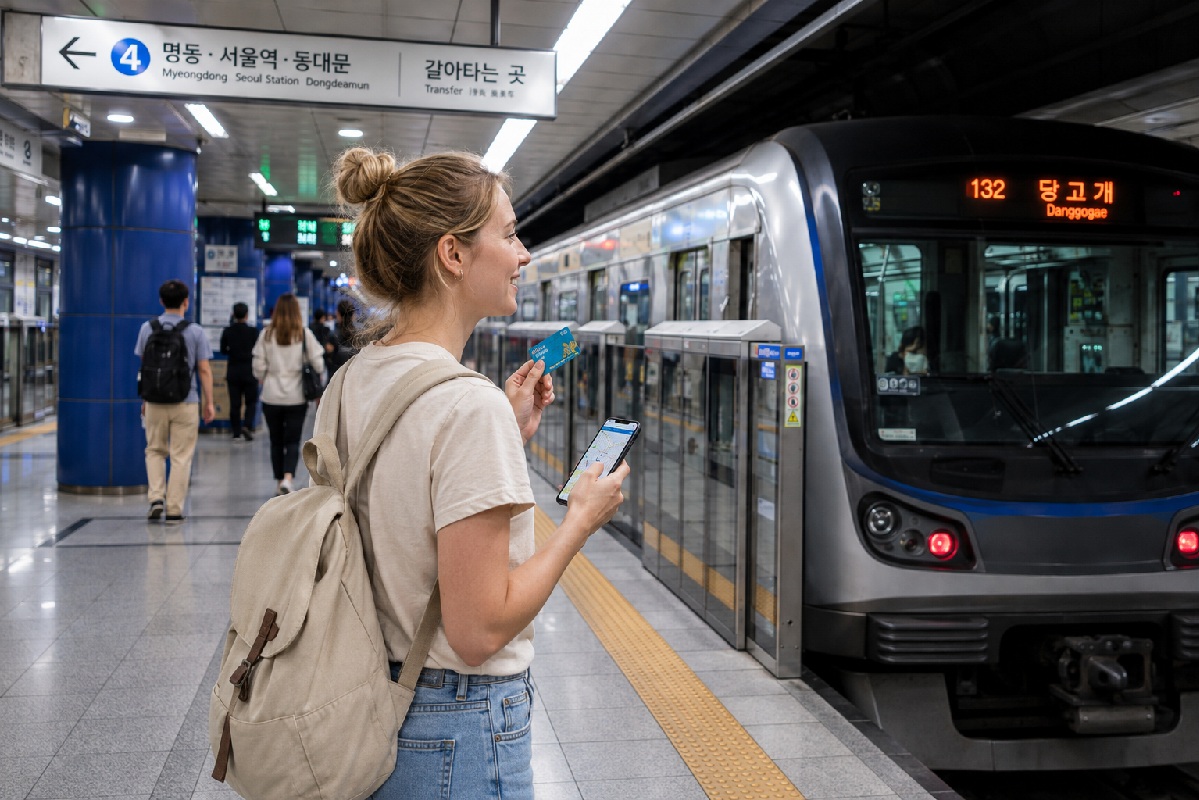
    Western traveler using a transportation card at a Seoul subway station

    3. How to Use the Subway

    Subway systems in major Korean cities are modern, clean, and relatively easy to navigate.

    Seoul has the largest subway network, but cities such as Busan, Daegu, Daejeon, and Gwangju also operate subway systems.

    When entering a station:

    1. Find the correct subway line.
    2. Check the direction of travel.
    3. Tap your transportation card at the gate.
    4. Follow the signs to the platform.
    5. Tap your card again when exiting.

    Many station signs include both Korean and English.

    4. Understanding Subway Directions

    One of the most common mistakes for first-time visitors is entering the correct line but traveling in the wrong direction.

    Before boarding, check:

    • the line number or color
    • your destination station
    • the next station
    • the final station shown for that direction

    Navigation apps can make this much easier.

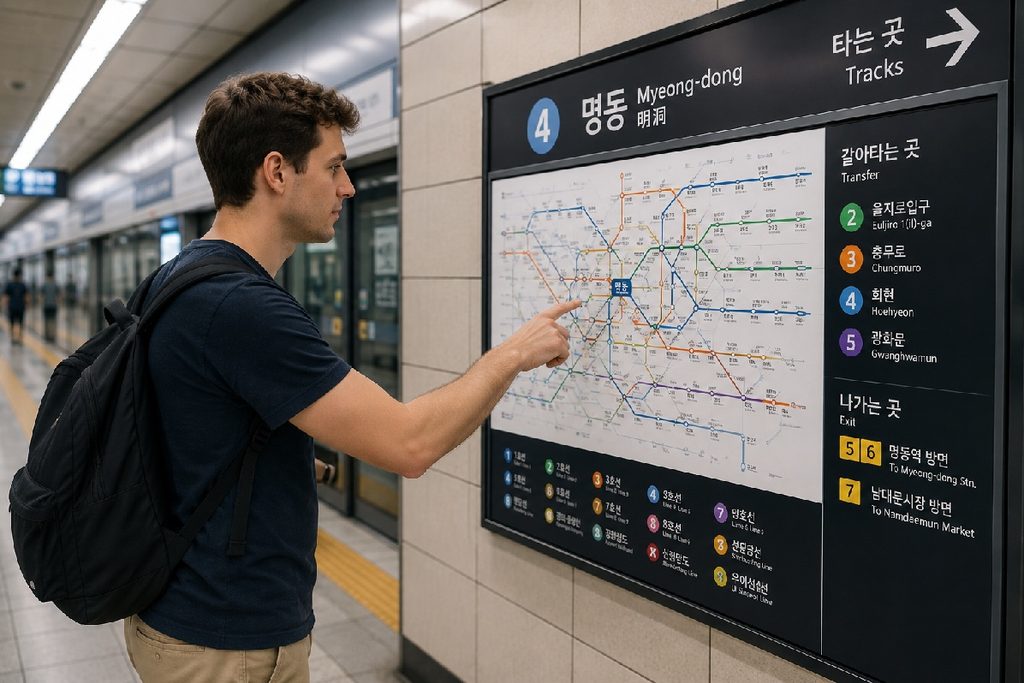
    Western traveler checking a Seoul subway map in South Korea

    5. Use Korean Navigation Apps

    Google Maps can be useful for general information, but local Korean navigation apps often provide more detailed public transportation information.

    Two widely used options are:

    • Naver Map
    • KakaoMap

    These apps can help you find:

    • subway routes
    • bus routes
    • transfer information
    • estimated travel times
    • walking directions
    • station exits

    Installing at least one local navigation app before your trip is highly recommended.

    6. How to Use City Buses

    Buses are an important part of public transportation in South Korea.

    In major cities, buses connect residential areas, attractions, subway stations, and neighborhoods that may not be directly served by the subway.

    When boarding a bus:

    1. Enter through the front door.
    2. Tap your transportation card on the reader.
    3. Watch the screen or navigation app for your stop.
    4. Press the stop button before your destination.
    5. Exit through the rear door when possible.
    6. Tap your card again when leaving.

    Tapping when you exit is important because it may affect transfer discounts and fare calculations.

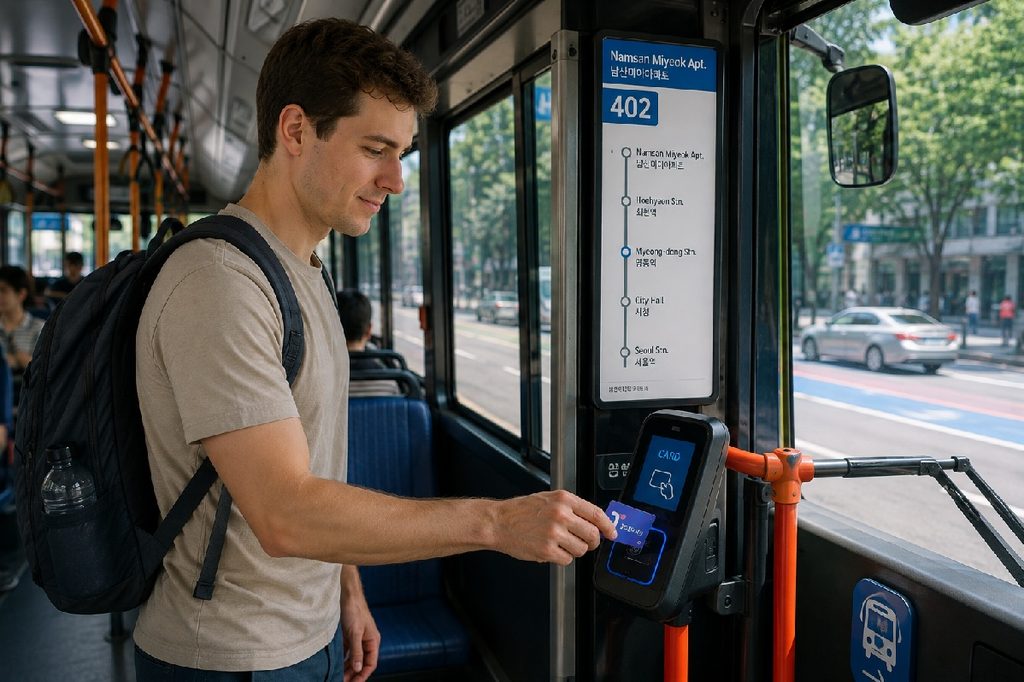
    Western traveler tapping a transportation card on a Seoul city bus

    7. Transfers Between Subway and Bus

    One major advantage of using a transportation card is that transfers between buses and subways can be more convenient.

    Depending on the city and transportation system, discounted transfers may be available when you transfer within a certain period.

    For this reason, always remember to tap your transportation card when entering and leaving buses and subway stations.

    8. Public Transportation Fares

    Public transportation in South Korea is generally affordable.

    The exact fare depends on:

    • the city
    • travel distance
    • transportation type
    • age
    • transfer conditions

    Longer journeys may include additional distance-based charges.

    Because fares can change, travelers should check current prices before traveling.

    9. Rush Hour in Korea

    Public transportation can become very crowded during weekday rush hours.

    Busy periods are often around:

    • morning commuting hours
    • evening commuting hours

    Seoul subway stations can become especially crowded during these periods.

    If possible, visitors who are carrying luggage or prefer a more relaxed journey may want to travel outside peak commuting times.

    10. Airport Transportation

    South Korea’s major airports are well connected to city centers.

    For travelers arriving at Incheon International Airport, common transportation options include:

    The airport railroad is often convenient for travelers heading toward central Seoul.

    Your best option depends on your destination, luggage, arrival time, and budget.

    11. Public Transportation Etiquette

    A few simple habits can make public transportation easier for everyone.

    Remember to:

    • wait for passengers to exit before boarding
    • avoid blocking subway doors
    • keep conversations relatively quiet
    • avoid placing large bags on seats
    • follow priority seating signs
    • move inside the train or bus when crowded

    Observing what local passengers are doing is often the easiest way to understand the expected behavior.

    12. South Korea Public Transportation Tips for First-Time Visitors

    Before using public transportation in Korea, it helps to prepare a few things.

    Make sure you have:

    • a transportation card
    • some Korean won
    • a navigation app
    • mobile internet access
    • your accommodation address saved
    • your destination written in Korean when possible

    Also check the last subway or bus times if you plan to stay out late.

    Public transportation does not operate 24 hours a day in most places.

    Final Thoughts

    South Korea’s public transportation system may look complicated at first, but it becomes easy to use after only a few trips.

    A transportation card, a local navigation app, and basic knowledge of subway and bus rules will make traveling around Korea much more convenient.

    For first-time travelers, learning the transportation system is one of the best ways to explore South Korea independently and confidently.

  • South Korea Travel Tips: 12 Things to Know Before You Go

    South Korea Travel Tips: 12 Things to Know Before You Go

    Planning your first trip to South Korea can feel exciting and a little overwhelming at the same time.

    South Korea is modern, safe, convenient, and packed with things to experience—from Seoul’s busy neighborhoods and historic palaces to coastal cities, mountain trails, street food, cafés, and traditional markets.

    A little preparation can make your trip much easier.

    Here are 12 essential South Korea travel tips to know before you go.

    1. Get Connected as Soon as You Arrive

    Having mobile internet access makes traveling in Korea much easier.

    You will use your phone for navigation, translation, transportation information, restaurant searches, and messaging.

    Travelers commonly use:

    • eSIM
    • prepaid SIM cards
    • portable Wi-Fi devices

    If your phone supports eSIM, it can be one of the easiest options because you can arrange your connection before arriving.

    2. Use Korean-Friendly Navigation Apps

    Google Maps can be useful in Korea, but it may not always provide the same level of navigation detail that travelers expect in other countries.

    Two popular local navigation services are:

    • Naver Map
    • KakaoMap

    Both can help with public transportation, walking routes, restaurants, cafés, and attractions.

    Installing at least one of them before your trip is a good idea.

    3. Buy a Transportation Card

    Public transportation in South Korea is excellent.

    In major cities, buses and subways are usually the easiest way to get around.

    A rechargeable transportation card can be used on many buses and subway systems and can save you from buying individual tickets repeatedly.

    Keep a small balance available and recharge it when necessary.

    4. Seoul’s Subway System Is Easier Than It Looks

    The Seoul subway map may look complicated at first, but it is surprisingly easy to use.

    Stations are numbered, many signs include English, and transfer stations are clearly marked.

    Before boarding, check:

    • the line number or color
    • the station name
    • the direction of travel
    • the final station shown on the platform

    Once you use the subway a few times, navigating Seoul becomes much easier.

    For a more detailed guide, see our South Korea public transportation guide for first-time travelers.

    5. Keep Some Cash With You

    Credit cards are widely accepted in South Korea, especially in cities.

    However, carrying some Korean won is still useful.

    Cash may come in handy for:

    • traditional markets
    • small shops
    • street food
    • transportation card recharging
    • certain local businesses

    You do not need to carry a large amount, but having some cash available is convenient.

    6. Convenience Stores Are Extremely Useful

    Convenience stores are everywhere in Korea.

    They are more than places to buy snacks.

    You can often find:

    • bottled water
    • simple meals
    • coffee
    • toiletries
    • travel necessities
    • late-night food

    They can be especially useful when you arrive late or need something quickly.

    7. Korean Food Is Much More Than Korean BBQ

    Korean barbecue is famous, but it is only a small part of Korean cuisine.

    During your trip, consider trying dishes such as:

    • bibimbap
    • kimchi jjigae
    • samgyeopsal
    • tteokbokki
    • gimbap
    • mandu
    • kalguksu
    • fried chicken

    Traditional markets are also excellent places to experience local food.

    If you have dietary restrictions, preparing a translated explanation on your phone can make ordering easier.

    8. Learn a Few Basic Korean Phrases

    You can travel around major tourist areas without speaking Korean, but knowing a few simple expressions is helpful.

    Useful phrases include:

    Hello
    안녕하세요
    Annyeonghaseyo

    Thank you
    감사합니다
    Gamsahamnida

    Excuse me / Just a moment
    잠시만요
    Jamsimanyo

    How much is it?
    얼마예요?
    Eolmayeyo?

    Even a small effort to speak Korean is often appreciated.

    9. Respect Local Etiquette

    Korean society places importance on courtesy and respect.

    You do not need to understand every cultural rule, but a few habits are useful.

    For example:

    • speak quietly on public transportation
    • wait for passengers to exit before boarding
    • use both hands when giving or receiving something in formal situations
    • avoid blocking subway doors or escalators
    • follow posted rules at temples and historic sites

    Simply paying attention to what people around you are doing will help.

    10. Korea Is Great for Independent Travel

    South Korea is a convenient destination for travelers who prefer exploring without organized tours.

    Public transportation connects many destinations, and major cities have a wide range of accommodation options.

    Popular destinations include:

    • Seoul
    • Busan
    • Gyeongju
    • Jeju Island
    • Jeonju
    • Sokcho
    • Gangneung

    You can combine several destinations depending on the length of your trip.

    11. Do Not Try to See Everything

    One common mistake is planning too many activities.

    Seoul alone can easily fill several days.

    Instead of rushing between attractions, leave time to explore neighborhoods, cafés, markets, parks, and local restaurants.

    A slower itinerary often creates a much better travel experience.

    12. Prepare a Simple Plan Before You Arrive

    You do not need to schedule every hour of your trip.

    However, prepare a few basics before departure:

    • accommodation address
    • airport transportation plan
    • mobile internet option
    • navigation app
    • payment method
    • transportation card plan
    • list of places you want to visit

    Once those essentials are ready, you can explore Korea much more comfortably.

    Final Thoughts

    South Korea combines modern infrastructure with deep history, distinctive food, beautiful landscapes, and energetic cities.

    For first-time travelers, the country can seem unfamiliar at first, but transportation and everyday travel become much easier once you understand a few basics.

    Start with the essentials, keep your itinerary flexible, and give yourself time to explore beyond the most famous attractions.

    Korea Guide Lab will continue to publish practical guides covering transportation, destinations, food, accommodation, culture, and travel planning to help you make the most of your trip to South Korea.