
A kimchi making class in Seoul gives you a different souvenir: something you helped make, rather than something you picked from a shelf. For one afternoon, the interesting question is not which restaurant has the longest queue. It is what happens before that small dish of kimchi reaches the table.
Our suggested route keeps the experience compact: an English-language class at Museum Kimchikan in Insadong, a short wander through the neighbourhood, and tea nearby. There is no cross-city dash and no requirement to add a palace, a market and a second workshop.
The booking comes first. A published timetable is not a confirmed session. Check your date, the minimum class size and what you will cook before reserving the afternoon.
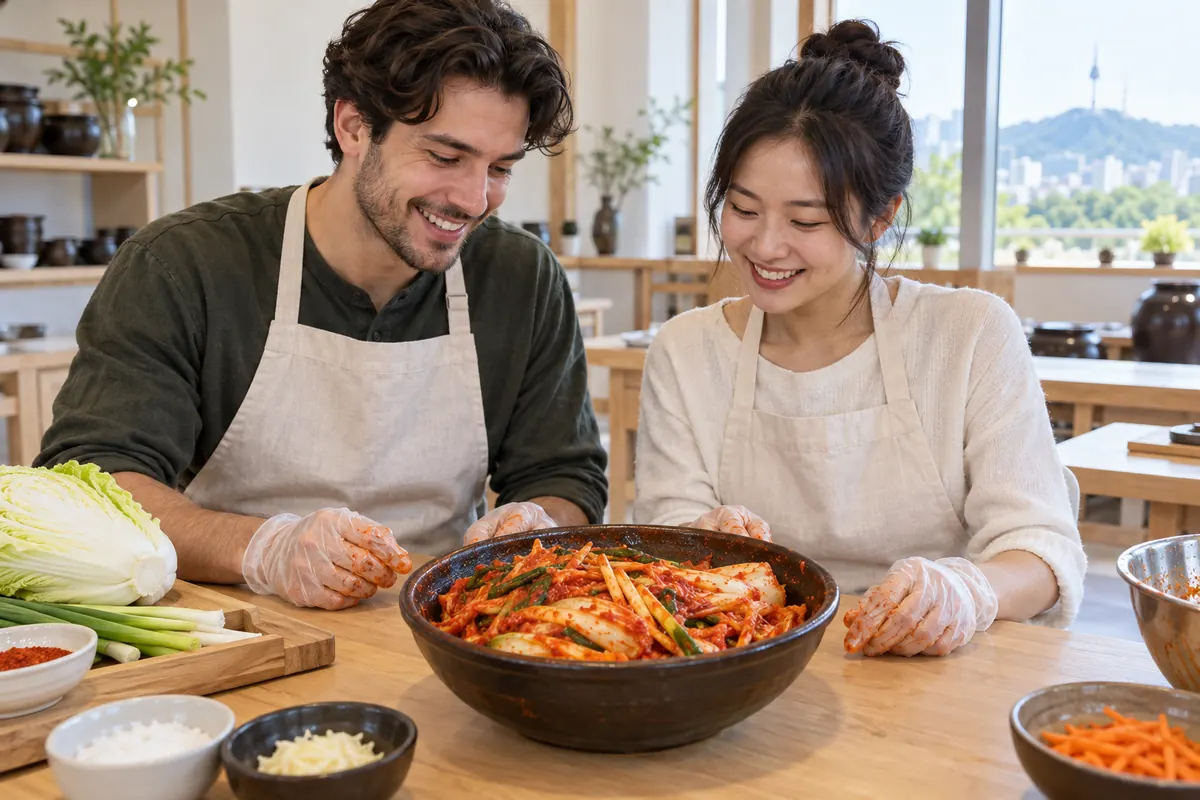
Checked October 26, 2026. Independently researched, not a firsthand class review. We inspected the official English programme and booking form but did not submit a reservation or test payment. Images below are AI-generated illustrations, not photographs of the named businesses.
1. Choose your kimchi making class before choosing the day
Museum Kimchikan offers more than one experience. Compare the official programme list, rather than assuming every ticket includes cooking.
- Museum only: adult admission is ₩5,000. This is the inexpensive choice for exhibitions, not a cooking-class ticket.
- Kimchi! Basic: the individual English programme lists 60 minutes and an adult total of ₩40,000, including admission. Consider it if making kimchi is the main attraction.
- Kimchi All-in-one: 90 minutes in English, with kimchi making plus a kimchi-based dish. Adult admission and class together cost ₩65,000. This is the option used in our afternoon plan.
The All-in-one listing gives Tuesday–Friday sessions at 10:00–11:30 and 14:00–15:30, with 4–12 participants. These are programme hours; use the live calendar to find an offered session. A solo traveller should ask whether they can join an existing departure, rather than assuming the four-person minimum means either guaranteed operation or a requirement to bring three friends.
October and November do not have the same menu
The published June–October curriculum combines kkakdugi, or cubed-radish kimchi, with a kkakdugi pancake. November–December switches to napa-cabbage kimchi and cheese kimchi fried rice. The operator may change the curriculum, so reconfirm your session. If you want to work with cabbage leaves specifically, an October booking is not the same experience.
This seasonal difference can make choosing easier. Are you curious about crisp radish kimchi, or do you want to understand the layered cabbage version you recognise from restaurant meals? Choose for the activity, not simply the longer duration.
2. Book your kimchi making class through the English form
Start on the English All-in-one page linked above. The English and Korean forms are not identical: the English form we inspected includes a phone-country selector. Do not conclude that a Korean phone number is compulsory merely because the Korean form begins with a domestic prefix.
- Select “Book Now”. Move to your travel month and look for a date marked “Open”. A blank calendar cell is not proof of a bookable session.
- Open the date, then select its session. Check the time and remaining places. During our check, December 1 at 14:00 appeared as a selectable session; that observation is not a promise of availability when you read this.
- Enter the reservation details. The form asks for a name, email, nationality, participant numbers and food-allergy information. The phone field has a country-code selector.
- Complete email verification. Use “Request Code”, then enter the six-digit code and select “Verify”. You need access to that inbox; we did not request a code or submit anyone’s details.
- Read the next-stage conditions before finishing. Confirm the final total, payment method and booking status. We have not verified overseas-card payment or the final confirmation process. Keep the operator’s confirmation, not just a screenshot of the timetable.
If the form or date does not work for you, contact museum@pulmuone.com or +82-2-2088-8531. Send your preferred date, morning or afternoon, party size and questions about payment or dietary needs. Do not invent a local number to get past a field.
Cancellation matters: the operator sets a cutoff of 10:59 a.m., three days before the experience, for cancellations or headcount changes. Its terms say late changes still require payment for the reserved number, and late cancellation can block future bookings for six months. Read the current conditions before committing.
A useful message to send before booking
Hello, I would like to join the English Kimchi All-in-one class on [date] at [time] for [number] people. Is the session confirmed to run? I use an overseas phone number. How should I complete payment, and can you accommodate [specific dietary requirement]? Thank you.
A reply about ingredients is more useful than guessing from the photograph. Explain exactly what you cannot eat and ask whether substitutions and shared equipment make the class suitable. An English-language class is not automatically vegan, halal or allergy-safe.
3. An Insadong afternoon with one main event
Destination: Museum Kimchikan, Insadong Maru main building, floors 4–6, 35-4 Insadong-gil, Jongno-gu, Seoul (서울 종로구 인사동길 35-4). The museum’s official directions point to Anguk Station, Line 3, Exit 6, or Jonggak Station, Line 1, Exit 3. Allow about ten minutes from either station and extra time to find the building and reach reception on the fourth floor.
The schedule below is our suggested pacing for a confirmed 14:00 class, not an additional programme sold by the museum.
- 12:30–13:00 — Arrive and eat if you need lunch. Keep it modest. The class includes tasting, but that is not a reason to arrive hungry or assume it replaces a full meal.
- 13:00–13:30 — Browse Insadong-gil. Look at ceramics, paper goods or one gallery that catches your eye. Leave the serious shopping until you know how much you want to carry.
- 13:30–14:00 — Reach the museum and check in. Follow the arrival time in your confirmation. Ask when to visit the exhibitions and how to care for the kimchi afterwards.
- 14:00–15:30 — Take the class. Put your phone away for the parts that need your hands. A photograph of the result is less useful than remembering the step you found surprising.
- After 15:30 — Tea nearby, if storage advice allows. Keep the stop short and return to your accommodation as appropriate for the kimchi. If it needs prompt refrigeration, reverse the order: tea before class, then straight back.
Do not turn this into an endurance route. A second timed activity adds little if you are watching the clock or worrying about a food container. If you prefer a non-food souvenir instead, our Insadong name-stamp guide offers a separate option; it is not a compulsory extra stop.
For step-free travel, check your station exit and the full building route before booking. The museum describes an elevator to reception, but that does not establish that every part of your journey or every nearby tea room is accessible. Use our transport-card comparison for the wider transit choice, rather than rebuilding that decision on class day.
4. A real tea stop, with a realistic budget
Yetchatjip (옛찻집), at 33-1 Insadong-gil, is a nearby candidate rather than a second destination across town. The Korea Tourism Organization lists traditional drinks including ssanghwacha, jujube, ginger and citrus tea, with snacks such as grilled rice cake and yakgwa. See the tourism listing.
For a first order, consider citrus tea if you want a sweet, familiar starting point, or ask about ssanghwacha if you are curious about a more herbal drink. Check the actual ingredients and toppings when needed; a traditional name does not tell you everything in the cup.
A public visitor account collected by Diningcode reports ₩8,500 for ssanghwacha and cold plum tea, and ₩8,000 for oolong. These are reported reference prices, not an owner-confirmed current menu. Check the menu before ordering. Published hours also conflict between sources; confirm the day’s opening at 0507-1409-8780. The visitor listing places seating upstairs, so ask about access if stairs are a problem.

Our planning budget: allow about ₩75,000–₩80,000 per adult for All-in-one plus one tea. That is the ₩65,000 class total and a ₩10,000–₩15,000 tea allowance, not a package price. Transport, lunch and extra snacks are additional. The cheaper Basic class plus the same tea allowance would be roughly ₩50,000–₩55,000.
For two adults, All-in-one alone is ₩130,000. Decide whether the cooking is genuinely what both of you want; there is no need to buy the most expensive option just because it is labelled premium.
5. Your kimchi making class does not end at the classroom door
The museum says participants must take their kimchi away; a container and carrying bag are supplied, but shipping is not. Plan what happens next before booking. Ask the instructor for storage instructions for that batch and check whether your accommodation can provide suitable refrigeration.
This makes a class near the start or middle of your stay easier to fit than one immediately before a long transfer. Avoid planning hours of sightseeing with the container simply because the bag is convenient. Follow the operator’s handling advice, and do not assume the provided packaging is intended for a flight.
If you intend to take food abroad, check your airline, airport-security guidance and destination’s food-import rules separately. This guide does not establish that your kimchi can travel in cabin baggage or enter another country. Enjoying it during your stay may be the simpler option.
If the class does not run
Keep the museum-and-tea version as a smaller fallback. The museum’s visitor page lists Tuesday–Sunday opening, 10:00–18:00, last admission 17:30, with Monday and specified holiday closures. Individual exhibition visits do not normally require advance booking; the cooking experience is separate. Bring earphones for the multilingual audio guide.
A museum visit will not replace the hands-on session, and we would not sell it as the same afternoon. It can still work if you want to understand the food without committing to cooking, taking kimchi home or waiting for a class to reach its minimum.
The best outcome is not collecting another certificate. It is returning to a restaurant and noticing something about the kimchi that you would have missed before: the cut of the vegetable, the texture, or a flavour you now have a question about.
Sources and what we did not verify
Programme prices, curriculum and conditions come from Museum Kimchikan’s official pages linked above, checked October 26, 2026. The booking walkthrough is based on its visible English form, not a completed purchase. Tea prices are clearly labelled visitor-reported references. The afternoon sequence and budget allowances are our planning suggestions. No class attendance, business visit, overseas payment or dietary accommodation is claimed.