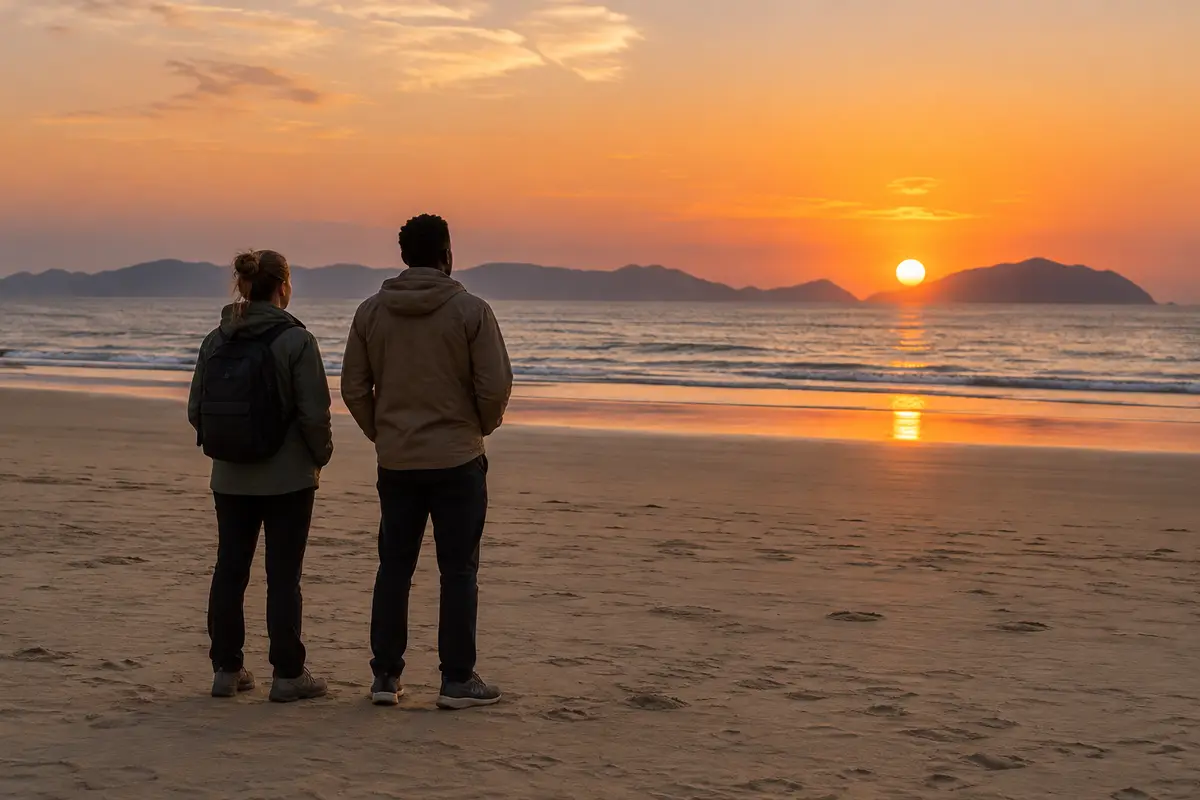
A Dadaepo sunset itinerary should leave room for doing very little. Walk through the reeds, find a place on the sand and let the light change. This is the Busan afternoon to choose when another crowded shopping street sounds less appealing than a wide horizon.
The catch is geography: Dadaepo sits at the southwestern end of the city. It works well as a dedicated afternoon, not as a quick extra after Haeundae. This route keeps the beach as its main event and puts dinner close to the metro afterward.
Important for autumn 2026: Saha District says the Sunset Fountain operates only through September in 2026 because construction is scheduled from October. Do not travel expecting a fountain show. Check the official operating notice for later reopening information.
Research checked: October 15, 2026. This is a researched itinerary, not a report of a personal visit. Restaurant details come from public listings and can change.
Plan your Dadaepo sunset itinerary around the light
Allow about 4–5 hours locally, plus the journey from your hotel. Look up Busan’s sunset time for your actual date, then work backward. A summer timetable copied into an autumn visit is an easy way to arrive too late.
- Three hours before sunset: arrive at Dadaepo Beach Station, use the toilet and have a late lunch or café break.
- Two hours before sunset: take a relaxed Gouni boardwalk walk. Allow 30–45 minutes for a short out-and-back rather than forcing a full circuit.
- 45–60 minutes before sunset: move onto the beach and settle on a safe, accessible stretch of sand.
- After sunset: have dinner near the station, then return by metro.
Those walking times are planning allowances, not measured route guarantees. If you arrive with less than an hour of daylight, skip the boardwalk and go straight to the beach. The sunset will not wait for your checklist.
Jump to: transport · reed walk · sunset · restaurants · budget and bad weather
1. Take Line 1 to the beach, not the port
Search for Dadaepo Beach Station (다대포해수욕장역), the southern terminus of Busan Metro Line 1. Do not get off at Dadaepo Harbor Station (다대포항역) simply because the name looks similar. Visit Busan’s walking guide uses Exit 2 for the beach-side ecological walk.
From Busan Station or Nampo, stay on Line 1 toward Dadaepo Beach. From Seomyeon, use the same southbound line. From Haeundae, take Line 2 toward Seomyeon and transfer to Line 1; this is a cross-city outing, not a neighboring beach hop.
For a conservative hotel-to-beach planning buffer, reserve roughly an hour from the Busan Station/Nampo area, 75–90 minutes from Seomyeon and around two hours from Haeundae. These are deliberately generous allowances including access and waiting, not published train journey times. Check a live route before leaving and save the return journey too.
Carry a charged transport card; our T-money guide explains the basics. Leave large luggage at your accommodation. Sand, a suitcase and a long metro ride are a poor combination.
2. Walk among the reeds before the beach
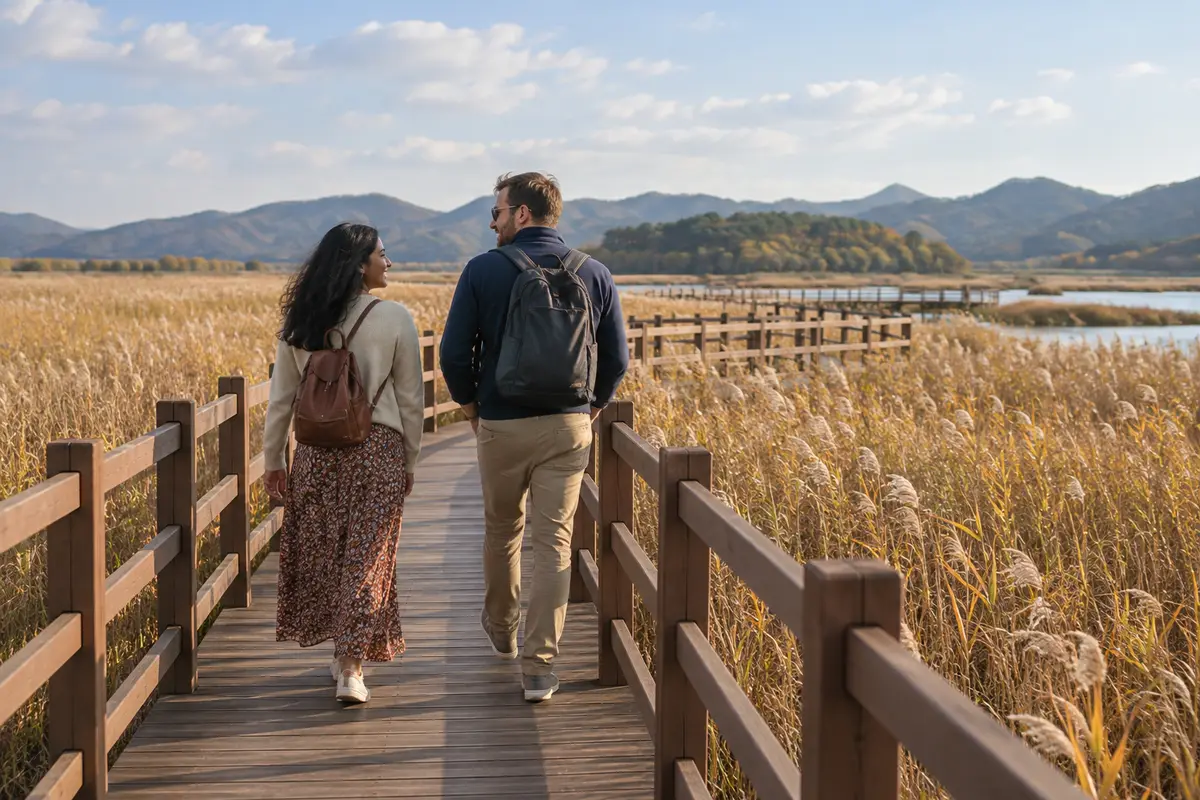
Gouni Ecological Trail (고우니생태길) makes the afternoon feel different from Busan’s built-up eastern beaches. The appeal is the shift in scale: reeds close to the wooden path, then open estuary scenery beyond them. Visit Busan includes it in its Dadaepo walking route.
Keep this part gentle. Choose a short section and turn back when you have had enough; you do not need to collect every viewpoint. Stay on designated paths, give other walkers room and follow any maintenance closures. A boardwalk being relatively level does not make the entire beach itinerary step-free: sand and access points still matter for wheelchairs and strollers.
On a windy day, shorten the walk rather than trying to prove you can finish it. Bring a light windproof layer even if the city felt warm earlier. Buy drinks before heading away from the station area, and carry your rubbish back.
Should you add Amisan Observatory?
Only if you arrive early and genuinely want the higher estuary view. Amisan Observatory (아미산전망대) is at 77 Dadaenakjo 2-gil. Visit Busan lists Tuesday–Sunday, 09:00–18:00, with entry by 17:00; check holiday exceptions before making a special trip.
It is an additional uphill-area stop, not part of the flat beach walk. Use a live map for the connection and allow extra time. For a relaxed first visit, choose either the observatory extension or a longer boardwalk wander. Trying to watch the final sunset from both the hill and the sand defeats the point.
3. Give the sunset an unhurried hour
Reach the beach while there is still useful light. Find a spot with a straightforward route back, put your phone away for a few minutes and watch how the sky changes. A clear view of the sun is never guaranteed: cloud cover can hide it, and some evenings are more muted than the photographs suggest.
Do not chase a reflection across exposed tidal flats. Water levels, soft ground and visibility change. Stay in permitted beach areas, obey local signs and keep clear of channels and closed sections. A reflective photograph is not worth an unsafe walk.
Wear shoes you can clean, bring an extra layer and keep enough battery for the return route. After the light fades, return toward the lit public paths rather than extending the ecological walk in darkness. This is also a good reason to settle dinner plans before sunset.
4. Choose dinner by appetite, not a detour
Here are two nearby food options to check. Neither is presented as a personally tested “best restaurant.” Public menus help with budgeting, but the menu at the restaurant takes priority. Search the Korean name and street address together to avoid similarly named branches.
Nakjibari Myeotgaego — octopus, offal and shrimp
낙지발이몇개고 · 694 Dadae-ro, 2nd floor · 0507-1480-7605. The public listing shows 11:00–22:00, last order 21:00, and Thursday closed. Confirm before going.
Its listed nakgopsae is ₩14,000 per portion: octopus, intestines and shrimp in a spicy pan. Nak-sam-sae, replacing the intestines with pork belly, is also listed at ₩14,000. For two, two portions plus one ₩2,000 noodle addition give a ₩30,000 food starting point; ask whether rice is included and whether a minimum portion order applies.
This suits travelers curious about Busan-style spicy shared food, not anyone avoiding shellfish or offal. Ask about a mild version before ordering; “mild” is not a promise of no heat. The listing tags reservations as possible: call ahead, or ask your accommodation to help. An English-language booking channel was not verified.
The listing showed 5/5 from just three ratings—a positive but very small sample, not evidence of universal acclaim. Check the menu and reviews.
Bokkeumyeon Dwaeji — a simpler pork set meal
볶으면돼지 · 11 Dadaenakjo 1-gil, 2nd floor · 051-264-8373. Its public menu lists both gochujang pork and soy-sauce pork set meals at ₩13,000. Two sets therefore start at ₩26,000 before extras.
The soy-sauce option is worth asking about if the shared seafood-and-offal pan is not for you. Confirm ingredients and spice level rather than assuming it is allergy-safe or suitable for every dietary restriction.
Published hours vary by day and include afternoon breaks and shorter service on some days. Treat this as an early-meal alternative, not a guaranteed late dinner. Phone before building your sunset schedule around it; no verified English reservation method was found. See the listed menu and daily hours.
Budget, bad weather and the return trip
For two adults, allow ₩26,000–₩30,000 for one basic meal using the examples above, plus a discretionary ₩12,000–₩18,000 café allowance. That produces a ₩38,000–₩48,000 local food-and-drink plan, before transport, alcohol and extra dishes. The café amount is a budgeting allowance, not a quote from a named shop. A second full meal costs extra.
The core plan does not depend on a ticketed show or attraction reservation. Restaurant seating and opening are separate matters; keep a backup near the station and avoid arriving minutes before last order.
- Light cloud, manageable wind: keep the walk but lower your expectations of a vivid sunset.
- Heavy rain or strong wind: postpone the beach. A café cannot replace the reason for a long cross-city trip.
- Tired legs: skip Amisan, shorten the boardwalk and spend your remaining time at the beach.
- Staying in Haeundae: plan the return before dinner. Do not assume late-night trains or transfers will work without checking.
- Departure day: avoid this route if it leaves a tight margin for a train or flight. Dadaepo belongs in a flexible afternoon.
If you would rather stay on the eastern waterfront, choose our Gwangalli–Suyeong–Haeundae route. If you want a compact city walk from the railway station instead, use the Busan Station and Choryang itinerary. They are alternatives, not extra stops to bolt onto this evening.
Before you leave
Check the sunset time, weather, return metro route and your chosen restaurant’s hours. Pack a windproof layer and keep your evening flexible. The best version of this Dadaepo sunset itinerary is not the one with the most stops—it is the one that gets you onto the sand with time to spare.
Sources and image note
- Visit Busan: Dadaepo walking route — station exit and ecological trail.
- Visit Busan: Amisan Observatory and Busan City observatory information.
- Saha District: Sunset Fountain operating notice — 2026 early seasonal closure.
The two travel images are photorealistic AI illustrations inspired by the setting, not documentary photographs of Dadaepo or evidence of a personal visit. Restaurant information is linked separately above. Recheck operating details close to your travel date.