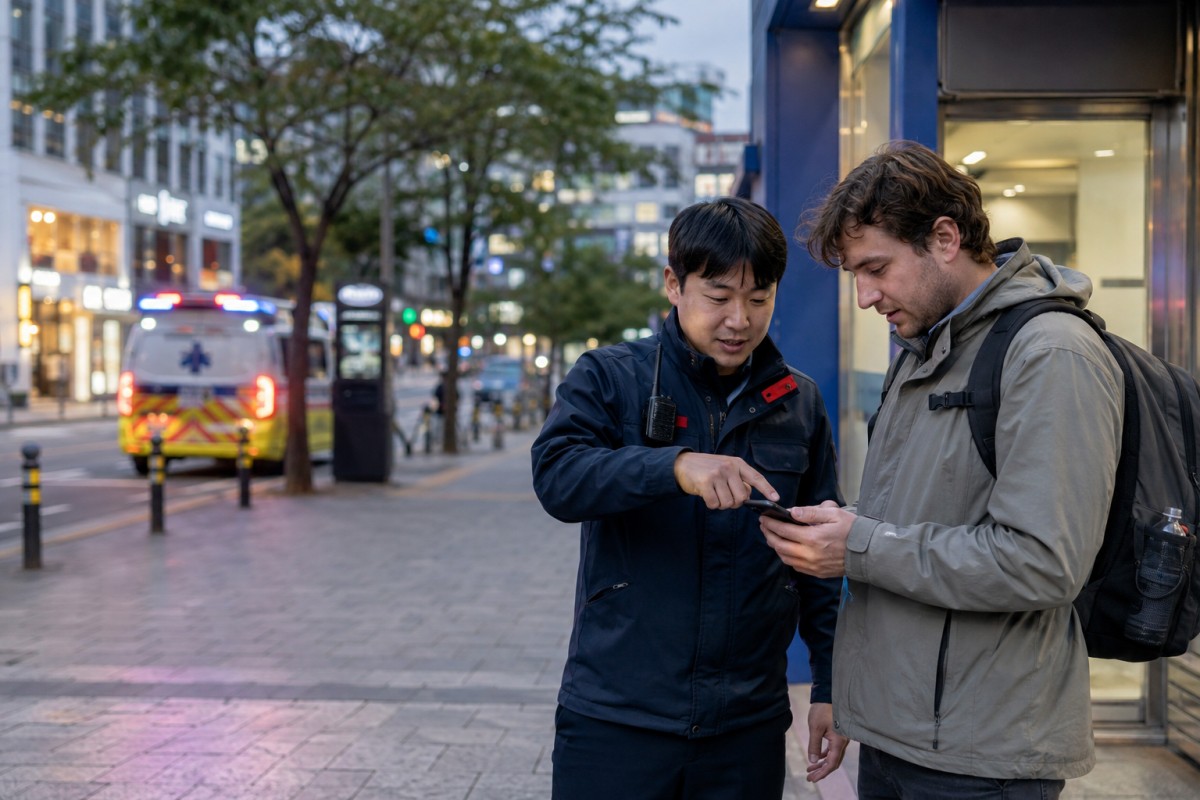
In an emergency, give your location before trying to explain everything. Use 112 for police and 119 for ambulance, fire or rescue. Keep the accommodation address in Korean and be ready to name a nearby landmark. Travel-information lines can help with ordinary problems, but they are not a substitute when someone is in immediate danger.
Save the short table below before your trip. For a threat to life, personal safety or property, call 112 or 119 first. Numbers such as 1330, 1345 and 120 are support lines, not substitutes for an emergency response.
Korea emergency numbers at a glance
| Number | Use it for | Emergency? |
|---|---|---|
| 112 | Police, crime, immediate danger, theft in progress | Yes |
| 119 | Ambulance, fire, rescue, medical emergency | Yes |
| 1330 | Tourist information, interpretation and travel assistance | No |
| 1345 | Immigration, visa, stay status and multilingual foreigner support | No |
| 182 | Police information and lost-property guidance | No |
| 1339 | Infectious-disease information and reporting | No |
| 120 | Seoul city services, transport and local administration | No |
Fast decision: danger or crime = 112. Ambulance, fire or rescue = 119. Unsure but not in immediate danger = 1330 for tourist assistance.
112: police, crime and immediate danger
Call 112 when you need the police: assault, stalking, threats, theft in progress, a serious traffic incident, or another situation in which people or property are at immediate risk. The Korean National Police Agency lists 112 as the crime-report number. If an item was simply misplaced and there is no danger, use the location’s lost-and-found service or call 182 instead.
When the operator answers, say “English, please” or “Interpreter, please.” The Korea Tourism Organization advises international visitors to state their language need and use a nearby building, road sign or the phone’s GPS to identify their location. See the official disaster safety guide for international visitors.
What to tell the 112 operator
- What happened: theft, assault, threat, accident or suspicious behavior.
- Where you are: building name, subway exit, road sign, hotel or shop.
- Whether anyone is injured or the suspect is still nearby.
- Your description: clothing, nationality or another easy identifier.
- A callback number if you have one.
Move to a staffed, bright public place if it is safe. Do not follow a suspected thief or enter a private location because a tracking app shows a moving device. For a missing device rather than a crime in progress, use our lost phone in Korea guide.
119: ambulance, fire and rescue
Call 119 for a medical emergency, fire, rescue situation or serious accident. Examples include difficulty breathing, loss of consciousness, severe bleeding, a suspected stroke or heart attack, a dangerous fall, or a building fire. VisitKorea lists 119 for fire and medical emergencies.
Do not spend time searching for a specific hospital during a life-threatening emergency. Call 119, describe the symptoms and location, and follow the dispatcher’s instructions. If the problem is urgent but not life-threatening, our Korea hospital guide explains clinics, emergency rooms, insurance documents and international care centers.
The location sentence that saves time
Open a map and read or show the Korean address. A useful structure is: “I am at [place], near [landmark].” In a subway station, include the line, station name and exit number. In a large building, include the floor and shop name. On a highway, look for a route number, tunnel name, rest area or kilometer marker.
1330: the traveler’s multilingual help line
1330 is the Korea Tourism Organization’s travel helpline. It supports tourist information, interpretation and complaints, and it can help connect travelers with relevant agencies. From outside Korea, the published number is +82-2-1330. Language availability and hours can differ, so check the official 1330 service page.
Use 1330 when you are safe but blocked by language or local knowledge—for example, you cannot explain a problem to a taxi company, need help finding the right public office, or want interpretation during a non-life-threatening travel problem. If someone is in danger, call 112 or 119 directly first.
1345: immigration and visa help
Call 1345 for immigration matters: visa questions, permitted stay, immigration-office jurisdiction, residence procedures and related support for foreigners. The Korea Immigration Service says the multilingual contact center operates on weekdays from 09:00 to 22:00; after 18:00, service is available in Korean, English and Chinese. From abroad, use +82-2-1345. Confirm current details on the official Immigration Contact Center page.
A lost passport is both a police-and-embassy problem and a departure-document problem. Follow our lost passport in Korea guide for the correct order: police documentation, embassy contact, replacement travel document, immigration and airline checks.
182: lost property and non-emergency police guidance
Use 182 for police information and lost-property guidance when there is no immediate danger. Korea’s national police lost-property portal is LOST112. A newly found item may remain at a station office, taxi company or business before it is transferred and registered, so contact the original location and repeat the database search later.
If you witnessed theft or someone is threatening you, do not wait for a lost-property record—call 112. For a misplaced phone, follow the step-by-step lost phone recovery guide, including Find My or Find Hub, station and taxi tracing, SIM suspension and account protection.
1339: infectious-disease information
1339 is the Korea Disease Control and Prevention Agency call center for infectious-disease information, travel vaccination guidance and disease reporting. The KDCA lists the service as available 24/7. Its official English page directs foreign-language users to multilingual assistance through 1345, so check the current KDCA call-center guidance.
For severe symptoms or a medical emergency, call 119 rather than waiting on an information line. For ordinary medicine, prescriptions or a late-night pharmacy, see our Korea pharmacy guide.
120: Seoul city information
120 is Seoul’s Dasan Call Center for city services such as transport, tourism, municipal administration and complaints. It is useful for Seoul-specific problems but is not an emergency line. Seoul’s official safety page lists foreign-language consultation through 120, then option 9, with limited operating hours and languages. Check the current Seoul contact information before calling.
English and Korean phrases for an emergency call
| English | Korean | Simple pronunciation |
|---|---|---|
| English, please. | 영어로 부탁합니다. | Yeongeoro butakhamnida. |
| Please send the police. | 경찰을 보내 주세요. | Gyeongchareul bonae juseyo. |
| Please send an ambulance. | 구급차를 보내 주세요. | Gugeupchareul bonae juseyo. |
| Someone is injured. | 다친 사람이 있어요. | Dachin sarami isseoyo. |
| There is a fire. | 불이 났어요. | Buri nasseoyo. |
| I am at this address. | 이 주소에 있어요. | I jusoe isseoyo. |
| I do not know my location. | 제 위치를 모르겠어요. | Je wichireul moreugesseoyo. |
A practical script when you call
Keep the first message short: “English, please. Ambulance. One person cannot breathe. We are at Myeongdong Station Exit 6.” The operator can ask follow-up questions. Do not begin with a long travel history; lead with the service, the immediate problem and the location.
- Put the phone on speaker if another person can show the map or assist the injured person.
- Do not hang up until the operator tells you to.
- Keep the path to the patient or incident clear.
- Send one person to a visible entrance to meet responders.
- Bring the traveler’s passport, medication list and insurance information if available, but do not delay urgent care to find paperwork.
Prepare these details before an emergency
- Save 112, 119, 1330 and your insurer’s assistance number in your contacts.
- Keep your hotel name and Korean address on paper.
- Save a photo of your passport identity page separately and securely.
- Write down allergies, medications and an emergency contact.
- Enable location services and an offline map, but carry a paper fallback.
- Teach children or travel companions the hotel name and the numbers 112 and 119.
Your phone is useful, but it should not be the only copy of essential information. Our best apps for Korea travel guide explains navigation and translation tools; keep one printed address and emergency contact as the low-tech backup.
Frequently asked questions
Can I call 112 or 119 without speaking Korean?
Yes. Say “English, please” or “Interpreter, please,” then state the emergency and location in short phrases. If the situation is not urgent and you mainly need tourism interpretation, call 1330.
Which number should I call for a stolen passport?
Call 112 if the theft is recent, in progress or involves danger. You will also need to contact your embassy or consulate and may need immigration guidance before departure. Use the dedicated lost-passport guide linked above.
Is 1330 an ambulance or police number?
No. It is a multilingual tourism information and assistance service. For immediate police help call 112; for ambulance, fire or rescue call 119.
What if I cannot describe my location?
Read or show the Korean address from a map, hotel card or receipt. Look for a subway exit, building name, shop sign, road number or nearby landmark. Turn on phone location services if possible and follow the operator’s instructions.
Official sources checked
- VISITKOREA: Emergency Situations
- VISITKOREA: 1330 Travel Helpline
- Korea Immigration Service: 1345 Contact Center
- Korea Disease Control and Prevention Agency: 1339
Last updated: September 16, 2026. Hotline hours, language support and procedures can change. Verify non-emergency services on the linked official pages. In immediate danger, call 112 or 119 without delay.