Read the charger label before buying an adapter. If the input supports the local voltage, you may only need the right plug shape; if it does not, a plug adapter cannot fix that. Be especially careful with heat-producing appliances. A charger that fits the socket is not necessarily safe to switch on.
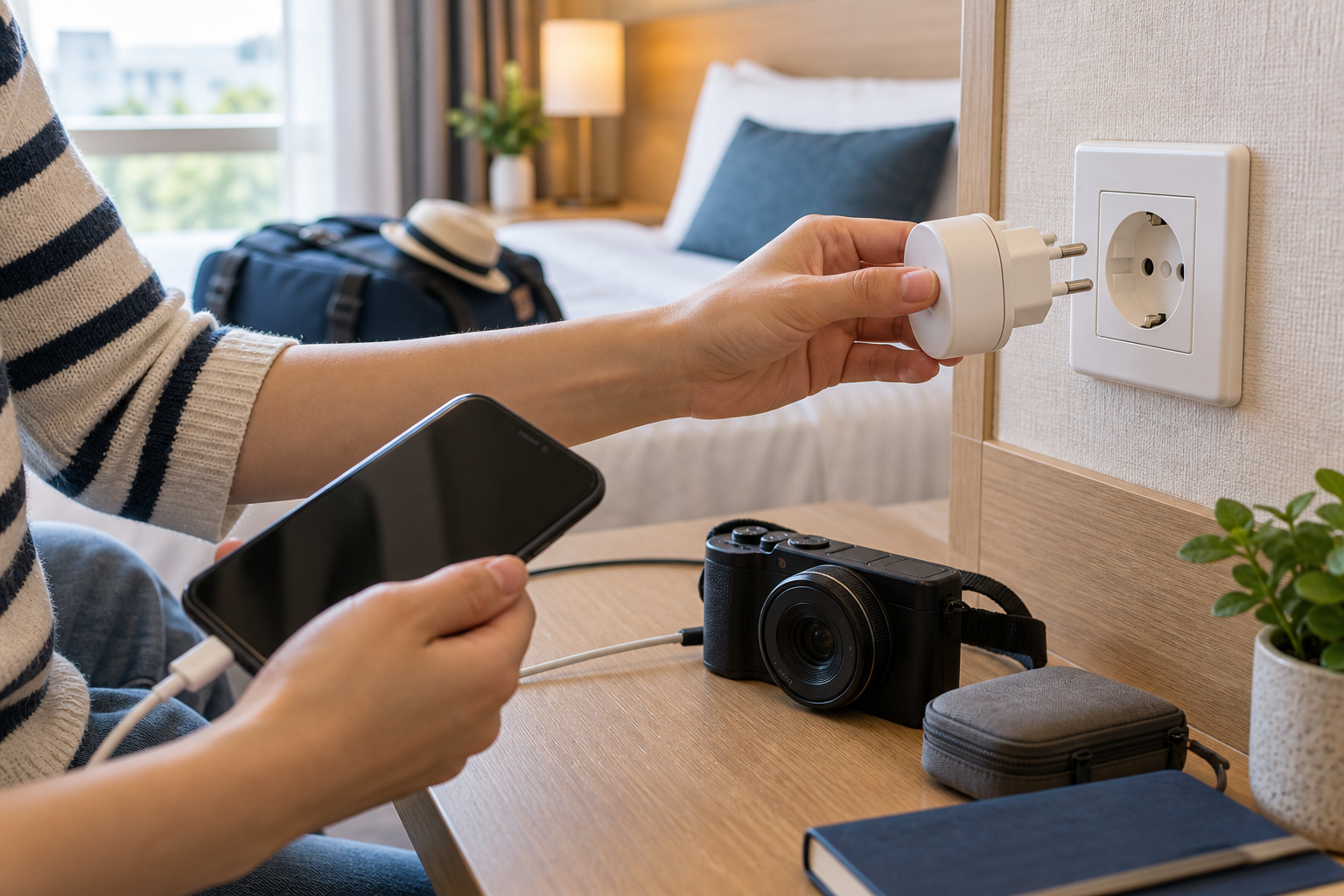
South Korea power plug: quick answer
- South Korea uses 220V electricity at 60Hz.
- Wall outlets have two round holes; Type F sockets are common and Type C plugs are generally compatible.
- Travelers from the United States, Canada, Japan, the United Kingdom, Australia and other non-round-pin systems normally need a plug adapter.
- If a charger says INPUT: 100–240V, 50/60Hz, it is dual-voltage and normally needs only the correct plug adapter.
- If an appliance says only 110V or 120V, do not connect it directly to a Korean outlet.
- A plug adapter changes the shape of the plug. It does not reduce voltage.
South Korea power plug checklist
- South Korea power plug voltage: 220V at 60Hz.
- South Korea power plug shape: two round pins, commonly Type F with Type C compatibility.
- South Korea power plug adapter: required when your device has flat, rectangular or angled pins.
- South Korea power plug safety: confirm the charger label says 100–240V and 50/60Hz before connecting it.
Use this South Korea power plug checklist before leaving home, then keep one compact spare adapter in a separate bag.
The 10-second label test
Find the tiny INPUT line on the charger, power brick or appliance. Use this table before plugging it in.
| Label on your device | What to do in Korea |
|---|---|
| INPUT 100–240V, 50/60Hz | Use a suitable Type C/F travel adapter; no voltage converter is normally needed |
| INPUT 220–240V, 50/60Hz | Use a plug adapter if the pins do not fit |
| INPUT 220–240V, 50Hz only | Check the manufacturer before using motors, clocks or timing-sensitive equipment on Korea’s 60Hz supply |
| INPUT 110V or 120V only | Do not plug it in directly; use a correctly rated transformer or leave it at home |
| Label missing or unreadable | Do not guess; use a replacement charger with a clear rating |
The input rating matters more than the country where you bought the device. Many phones, cameras, laptops and USB chargers sold in North America or Japan already accept 100–240V. High-heat appliances are much less predictable.
Adapter and converter are not the same thing
A plug adapter changes the pin shape
An adapter lets a foreign plug fit Korea’s two-round-hole outlet. It does not change 220V into 120V. This is all most dual-voltage electronics require.
A voltage converter changes the electricity
A converter or transformer is needed for a genuinely 110V/120V-only device. It must be designed for the appliance’s wattage and for the length of use. A small travel converter that looks adequate for a shaver may be unsafe for a 1,500W hair dryer.
For a short trip, the safer answer for a single-voltage dryer, curling iron, kettle or heating appliance is usually to use the hotel’s equipment or buy a Korean-rated alternative rather than carry a heavy converter.
Which travelers need an adapter?
United States, Canada and much of Japan
Type A and B plugs have flat pins, so they do not fit a standard Korean round-pin outlet. Bring a well-made Type A/B-to-Type C/F adapter. Then check the voltage label separately—especially on hair tools.
United Kingdom, Ireland, Singapore and Hong Kong
Type G plugs need an adapter. Most modern chargers sold in these markets already accept 220–240V, but the device label is still the final authority.
Australia, New Zealand and China
Type I plugs need an adapter. Voltage is usually compatible for modern devices, but check both the input range and frequency.
Most of continental Europe
Many two-round-pin Type C plugs fit Korean Type F sockets. Grounded Type E/F plugs are often compatible as well, but bulky plugs and recessed sockets can vary. Carrying one compact adapter is still useful for hotels with worn or awkward outlets.
The devices most likely to cause trouble
Hair dryers, straighteners and curling irons
These draw substantial power. “Dual voltage” must be printed on the appliance itself, sometimes with a physical 110/220 selector. Set any selector correctly before use. If the label says only 120V, an adapter alone is not safe.
Electric shavers and toothbrushes
Do not assume a bathroom shaver socket is a universal high-power outlet. Check the charging base or power brick. Some low-power shaver sockets are isolated and are not intended for dryers or kettles.
CPAP machines and medical devices
Many medical power supplies accept 100–240V, but verify the exact model and manufacturer instructions. Bring the original power brick, a spare adapter and any essential battery approved by your airline. Do not rely on a hotel USB port for medical equipment.
Laptops, cameras and phones
The power brick normally carries the input rating. If it says 100–240V and 50/60Hz, use a plug adapter and the original charger. USB-C charging does not itself guarantee voltage compatibility; the rating on the charger does.
Korea’s 60Hz frequency: when does it matter?
Frequency rarely causes a problem for modern switched-mode chargers marked 50/60Hz. It can matter for 50Hz-only devices containing motors, analog clocks, timers or certain audio equipment. A plug adapter cannot change frequency. When the label does not include 60Hz, consult the manufacturer rather than experimenting in the hotel room.
How to choose a safer travel adapter
- Choose an adapter that firmly accepts your plug and fits a recessed round Korean socket.
- Check its maximum voltage, amperage and wattage; stay below every stated limit.
- Use a grounded adapter for equipment that requires grounding. Do not break off or bypass a ground pin.
- Prefer recognized safety certification and a physical shutter over a very cheap loose universal cube.
- Avoid stacking multiple adapters, splitters and heavy chargers from one wall outlet.
- Unplug an adapter that becomes unusually hot, smells burnt, buzzes or feels loose.
A universal adapter with USB ports can reduce luggage, but its USB output rating still needs to match your device. One quality charger with several ports is often safer and tidier than a chain of plug converters.
Where can you get an adapter in Korea?
VISITKOREA says adapters can be found at airports, retail stores, major duty-free shops and convenience stores, and some hotels may lend or sell one at reception. Availability is not guaranteed late at night or in a small guesthouse, so packing one before departure is easier.
Useful Korean phrases:
- Doejikon eodae isseoyo? (돼지코 어디 있어요?) — Where are the plug adapters? “Pig nose” is a common Korean nickname for a simple round-pin adapter.
- Igeon 220 volteu-yeyo? (이건 220볼트예요?) — Is this 220 volts?
- Eodaepteo billil su isseoyo? (어댑터 빌릴 수 있어요?) — Can I borrow an adapter?
If you buy one locally, show the plug on your charger and confirm that the adapter accepts that exact shape. Do not rely only on a package photo.
A simple hotel-room charging routine
On the first evening, inspect every charger before unpacking all your cables. Put the adapter directly into a firm wall outlet, connect the charger, then check it after ten minutes. Keep cables away from bedding and do not cover power bricks. Unplug high-power appliances when you leave the room.
For arrival-day planning, download the tools in our best Korea travel apps guide before your battery becomes a problem. Our SIM card, eSIM and pocket WiFi comparison helps you choose connectivity, while the South Korea travel tips guide covers the rest of the first-trip basics. If you need to buy an adapter after landing, plan the journey with our Incheon Airport to Seoul guide.
Packing checklist
- One quality Type C/F-compatible adapter per traveler
- Original phone and laptop chargers with readable input labels
- Short multi-port USB charger rated for 100–240V, if needed
- No 120V-only high-heat appliance unless you have a properly rated transformer
- A small spare adapter stored separately
- Airline-approved power bank packed according to the airline’s current rules
Official reference
- VISITKOREA: Electricity and Communications
- World Standards: South Korea plugs, sockets and mains voltage
The rule that protects your device
Read the INPUT label first. If it includes 220V and 60Hz, choose the correct plug adapter and charge normally. If it says only 110V or 120V, stop—an adapter is not a converter. That ten-second check is cheaper than replacing a charger, ruining a styling tool or creating an electrical hazard in your hotel.
Electrical ratings and hotel facilities vary. Follow the device manufacturer’s instructions and ask the accommodation for help when a plug, outlet or appliance appears damaged.