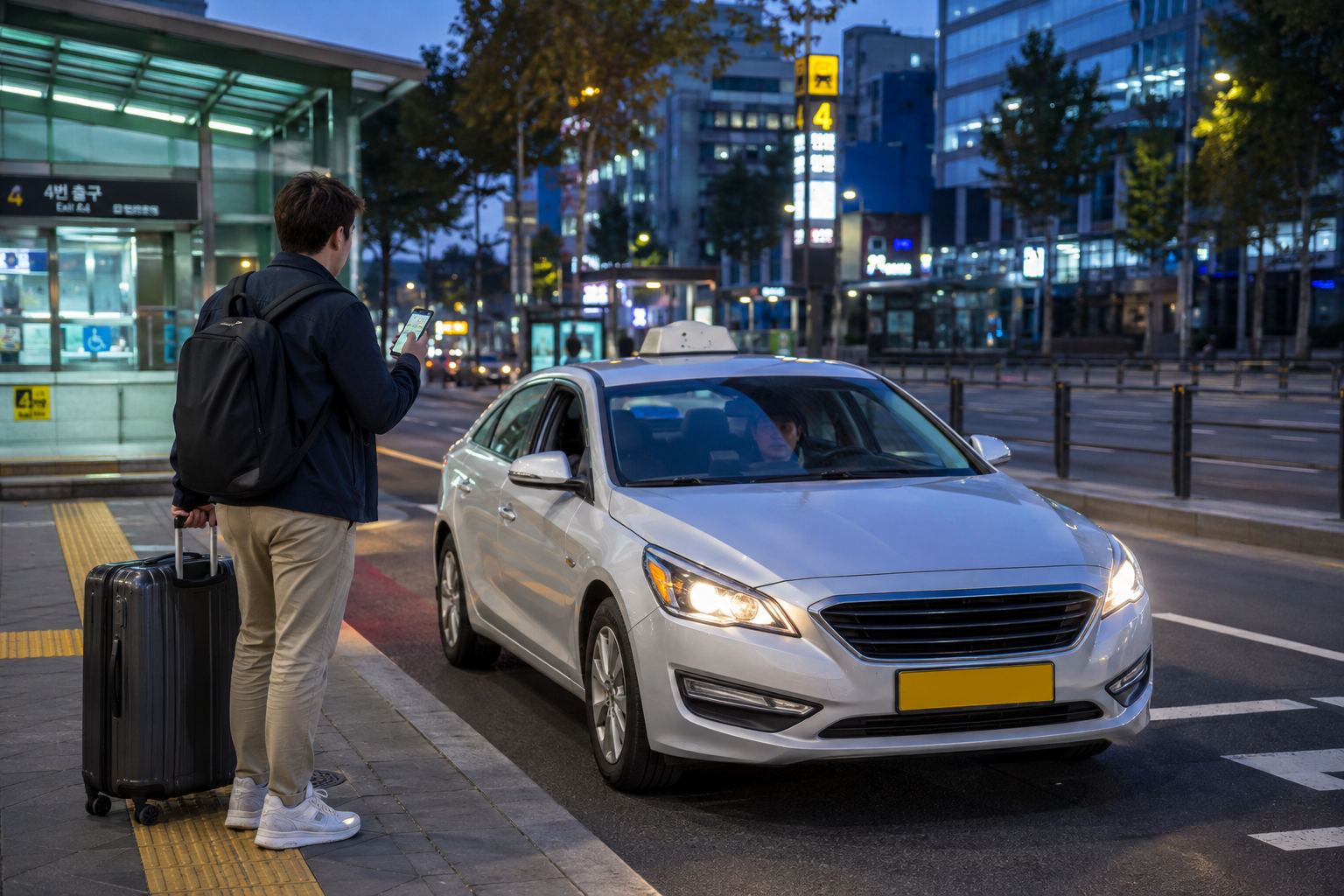
Have a destination the driver can use before you request a taxi. Save the Korean address and the correct entrance, especially for a hotel or large station. Then compare a taxi app, an official stand and public transport for that journey. A taxi is useful when it removes a difficult transfer; it is less useful when you still cannot explain where you need to get out.
Last reviewed: September 16, 2026. Taxi fares, surcharges, app features and payment acceptance vary by city, vehicle type and time. Check the app estimate, meter and local authority information before relying on a quoted price.
Quick answer
- Use a taxi app when possible because it records the pickup point, destination, driver and vehicle plate.
- Kakao T has broad coverage; k.ride is designed for international visitors and supports foreign cards and multilingual features. Uber Taxi can call participating Korean taxis through the existing Uber app.
- Regular taxis normally use a meter. City, late-night, out-of-area and vehicle-type rules can change the total.
- Standard taxis commonly accept cash, credit cards and transportation cards, but carry a backup payment method.
- No tip is normally required.
- Highway and bridge tolls can be added to the metered fare.
- Before entering, compare the license plate with the app and confirm the destination on your phone.
Table of Contents
- When a taxi makes sense
- Which taxi app to use
- How to call a taxi step by step
- Taxi stands and street hailing
- Choose the correct taxi type
- Understand fares and surcharges
- Airport taxi strategy
- Communicate the destination
- How to pay
- Safety and unfair-fare problems
- Useful Korean phrases
- Common mistakes
- Save-this checklist
When taking a taxi in Korea makes sense
Subways and buses are usually better for a predictable daytime trip through a large city. A taxi becomes valuable when it removes a difficult transfer or protects a tight schedule.
- Good taxi situations: two or more travelers sharing a short ride, large luggage, an early train, a late arrival, steep neighborhoods, rural attractions or bad weather.
- Situations to compare first: airport-to-city journeys, cross-city trips during rush hour and long intercity travel. Trains or buses may be cheaper and faster.
- Situations needing a larger vehicle: more than four passengers, several large suitcases, a wheelchair or bulky equipment. Do not assume a regular sedan can carry everything.
For the subway and bus alternative, start with our South Korea public transportation guide. For travel between cities, compare the intercity bus guide before booking a long taxi ride.
Which Korean taxi app should a visitor use?
k.ride: the simplest visitor-focused option
k.ride was created by Kakao Mobility for international visitors. It does not require a KakaoTalk account, supports major visitor languages and allows an internationally issued card to be registered. The app also provides destination search, a fare estimate, driver and plate information, and translated chat features. Availability and vehicle choices depend on location and time.
Kakao T: broad coverage and more local options
Kakao T is widely used across Korea and offers regular, deluxe, larger and premium vehicle choices depending on the city. Account setup can be less intuitive for a new visitor, so install and test it before the day you need an early-morning ride. If app payment is unavailable, look for the option to pay the driver directly.
Uber Taxi: familiar account, local taxi
If Uber Taxi is available in your area, the existing Uber app and stored payment information can be convenient. In Korea, the car may be a licensed local taxi rather than the private-car service a traveler expects elsewhere. Always check the product type, price display and plate before boarding.
Download at least two ride options over Wi-Fi and save the tools listed in our best apps for South Korea travel guide. A second app is useful when one service has no nearby drivers or rejects a foreign card.
How to call a taxi step by step
- Pin the correct pickup side. A divided road, bus lane or underground station exit can put the driver several minutes away even when the map looks close.
- Search the destination in Korean. Select the exact branch, terminal or hotel—not only a neighborhood name.
- Review the vehicle type. A premium or large vehicle can cost substantially more than a regular taxi.
- Check the payment method. Confirm whether the ride will charge in the app or be paid directly to the driver.
- Read the estimate carefully. An estimate may not include every toll, surcharge, waiting charge or route change.
- Wait somewhere legal and visible. Avoid bus stops, crosswalks, narrow alleys and locations where the taxi cannot safely stop.
- Match the plate. Check the last numbers and car description before opening the door.
- Show the destination screen. Confirm it before the car moves, especially when several businesses share a name.
Taxi stands and hailing a taxi on the street
Taxi stands are common near airports, railway and bus terminals, major subway stations, shopping centers and nightlife districts. Join the marked line and take the first appropriate car. Airport staff may direct different queues for regular, deluxe, large and international taxis.
You can also hail an available taxi from a safe roadside location. A red or illuminated availability sign may indicate that the car is free, but colors and displays vary. Do not step into traffic or wave from a bus-only lane. An app is usually easier when the destination is difficult to explain.
Choose the correct taxi type
- Regular taxi: the standard choice for one to four passengers with modest luggage.
- Deluxe or premium taxi: larger or higher-grade service with a higher base fare.
- Large or van taxi: designed for additional passengers or luggage. Capacity differs, so enter passenger and suitcase details when booking.
- International or tourist taxi: may provide language assistance, airport pickup or a fixed/section fare. It is a separate service, not automatically the cheapest option for a foreign passenger.
Do not select a premium product only because it appears first in an app. Read the name, capacity and price structure before confirming.
How Korean taxi fares work
Most regular taxis calculate a base fare plus distance and low-speed time on the meter. The exact starting fare and included distance are set locally. The Korea Tourism Organization’s 2026 taxi information lists a regular base fare of KRW 4,800 in Seoul, Busan, Incheon, Gyeonggi-do and Gwangju, while several other regions use different starting fares.
Seoul’s official standard sedan rate is KRW 4,800 for the first 1.6 kilometers during the daytime. The meter then adds distance or low-speed time. Treat that as a Seoul reference, not a nationwide promise.
Late-night surcharge
Late-night pricing commonly applies between 10 p.m. and 4 a.m., but the rate varies by city and time. In Seoul, a standard sedan surcharge is 20% from 10–11 p.m., 40% from 11 p.m.–2 a.m. and 20% from 2–4 a.m. The change should appear automatically on the meter.
Leaving the city and toll roads
An out-of-area surcharge can apply after a taxi crosses its licensed city boundary. Highway, tunnel and bridge tolls may also be added. These are not necessarily overcharges. Ask whether a toll road is planned when the app shows a surprising difference between routes.
App estimates and flexible pricing
Some branded or premium services use reported, pre-determined or flexible app pricing rather than a standard street meter. Confirm the product and displayed conditions before booking. A low estimate is not a guarantee if tolls, waiting or a changed destination are excluded.
Airport taxi strategy
Use only the official taxi queue or a confirmed reservation desk at the airport. Ignore unsolicited drivers approaching inside the terminal. At Incheon Airport, regular metered taxis, larger vehicles and international taxis can follow different fare structures.
- Confirm your terminal, hotel branch and full Korean address before entering the queue.
- Ask whether the price is metered or a published section/fixed fare.
- Clarify whether highway tolls are included.
- Keep the dispatch slip or receipt until hotel check-in.
- For a daytime arrival, compare AREX and limousine bus before deciding.
Our Incheon Airport to Seoul comparison explains the main options. If the final train has stopped, use the scenario-based after-midnight airport guide.
Show a destination the driver can use
A hotel’s English name is not always enough. Prepare a screen containing the Korean business name, road address and phone number. For a station, include the exit number. For an airport, specify the terminal and airline.
Keep your map open during the ride, but remember that a different route is not proof of dishonesty. Traffic, restricted turns, bus lanes and roadworks can make the driver’s navigation choose another path. Ask calmly if the car is moving in the wrong general direction.
How to pay for a taxi in Korea
Regular taxis commonly accept Korean won, credit cards and compatible transportation cards. Acceptance can still fail because of the vehicle terminal, card issuer or app. Before a long or late-night ride, keep at least two payment methods.
- Wait for the driver to stop the meter and show the final fare.
- Confirm whether tolls or an out-of-area surcharge were added.
- If paying directly, present the card or transportation card only when prompted.
- If app payment is active, check that you are not also charged manually.
- Request and keep the receipt. It helps identify the vehicle and explain a disputed charge or lost item.
No tip is normally expected. If a foreign card is declined, use the alternatives in our card-decline rescue guide and review the South Korea money guide.
Safety, lost property and unfair-fare problems
- Share the app trip or vehicle plate with a travel companion for a late ride.
- Use the seat belt and do not ask to be dropped where stopping is dangerous.
- Keep bags with you until the trunk is open at the destination.
- Take a receipt or screenshot of the driver and plate information.
- Do not agree to an unexplained cash price when a regular taxi should use the meter.
- If you feel unsafe, leave at a well-lit public place when it is safe to do so and contact emergency services.
For travel help, the Korea Travel Helpline is 1330. In Seoul, the Dasan Call Center can be reached at 120 within Korea; taxi QR complaint information and English surcharge details may also appear in the vehicle or on the receipt. For an immediate emergency, call 112 for police or 119 for fire and ambulance.
Useful Korean taxi phrases
- Yeogiro gajuseyo. (여기로 가주세요.) — Please go here.
- I juso-ga majayo. (이 주소가 맞아요.) — This is the correct address.
- Yeok sambeon chulgu-yo. (역 3번 출구요.) — Station Exit 3, please.
- Miteo kyeojuseyo. (미터 켜주세요.) — Please turn on the meter.
- Tonghaengnyo poham-ieyo? (통행료 포함이에요?) — Is the toll included?
- Kadeu dwaeyo? (카드 돼요?) — Can I pay by card?
- Yeongsujeung juseyo. (영수증 주세요.) — Please give me a receipt.
- Yeogi sewojuseyo. (여기 세워주세요.) — Please stop here.
Ten common taxi mistakes
- Pinning the opposite side of a divided road: confirm the pickup direction.
- Selecting a premium car by accident: read the product and estimate.
- Using only an English place name: save the Korean address.
- Assuming every app charges automatically: verify the payment method.
- Forgetting late-night pricing: expect surcharges after 10 p.m.
- Treating every toll as an overcharge: check the route and receipt.
- Booking a sedan for too much luggage: select an appropriate vehicle.
- Entering before checking the plate: match it with the app.
- Leaving without a receipt: keep proof for disputes and lost items.
- Relying on one card or one app: prepare backups.
Save-this Korea taxi checklist
- Install two taxi options and test account access before the trip.
- Save the destination name, Korean address and phone number.
- Pin a safe pickup point on the correct side of the road.
- Check vehicle type, estimate, payment method and late-night surcharge.
- Match the plate before entering.
- Carry a second card and Korean won.
- Ask whether tolls are included on an airport or highway trip.
- Keep the receipt and app trip record.
Official references
- VISITKOREA: Taxi types, fares, payment and call taxis
- VISITKOREA: Ride-hailing apps in Korea
- Seoul Metropolitan Government: Official taxi fare guide
The simplest rule
Use an app, match the plate, show the Korean destination and keep the receipt. Those four habits prevent most taxi confusion in Korea. The ride does not require perfect Korean—only a clear pickup point, the correct car and a payment backup.